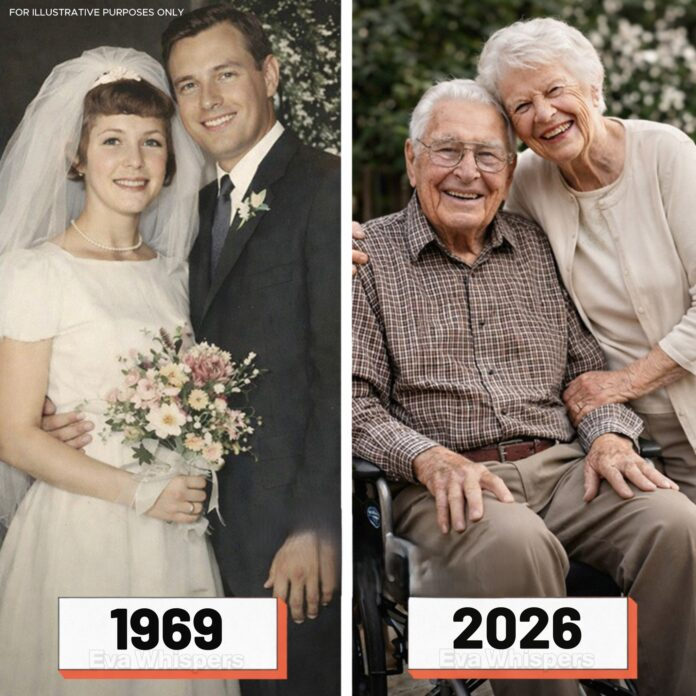
In our family, nobody ever described my grandparents’ marriage with grand words. No one talked about sweeping trips, dramatic anniversaries, or some glittering, perfect story that belonged in a movie.
If you asked what made them feel almost impossible in the best way, people would smile and say the same thing, every time.
“Saturday flowers.”
It became a phrase in our house the way certain sayings become part of a family’s language. Not a rule, not a demand. Just a rhythm. A certainty you could set your watch by.
Every single Saturday, my grandfather Thomas brought my grandmother Evelyn fresh flowers.
Not sometimes. Not when he remembered. Not when life was calm.
Every Saturday, without fail.
And the thing about it was how quietly he did it. It was never presented like an achievement. He didn’t tell stories about it at gatherings or make jokes about how long he’d kept it up. He did it like breathing, like paying attention to the small promises that keep a life stitched together.
Some Saturdays he’d come home with flowers that looked like they’d been laughing in the wind all morning. A wild handful from a roadside stand, stems still damp, daisies mixed with Queen Anne’s lace, loose and bright. Other times the bouquet was tidy and intentional, tulips lined up straight, vivid and proud, like they’d been standing at attention waiting for him to choose them.
In autumn he favored chrysanthemums, deep orange and rust, flowers that made the kitchen feel warmer even before anyone turned on the oven. The house always seemed to change when he walked in with them. The light looked softer on the countertops. The air felt fuller, like it had somewhere gentle to land.
He had a routine so dependable it might as well have been part of the home’s foundation.
He’d wake early, before the world had fully decided to be loud. In that hour, even the refrigerator’s hum sounded muted. He moved through the rooms with care, the way people do when love lives in the next room and you don’t want to disturb it.
The scissors would whisper as he found them. The faucet would run low, barely more than a trickle. He’d trim the stems slowly, as if each cut mattered. Then he’d fill the vase, straighten the bouquet, and set it on the kitchen table like a secret the morning was delivering on his behalf.
After that, he’d sit with his coffee, shoulders relaxed, the steam rising toward his face. He’d wait.
My grandmother would shuffle in later in her slippers, hair soft and tousled from sleep, robe tied loosely at her waist. She always did the same thing, as if it was a part she’d decided to play forever.
She’d pause at the doorway, as if she’d just noticed the arrangement for the first time in her life.
“Oh my,” she’d say, one hand lifting to her chest like a delighted actress. “Thomas. Again?”
And my grandfather, without ever pretending it was anything other than what it was, would lift his eyes over the rim of his mug and give her that crooked grin we’d seen in photographs for decades.
“It’s Saturday,” he’d answer.
Like that settled everything.
And it did.
They were married for fifty-seven years. A number that sounds tidy and impressive, but what it really means is that a lot of ordinary days happened. A lot of small irritations. A lot of mornings with bad hair and sore knees and bills on the counter. A lot of chores and colds and family worries and quiet joys.
Through all of it, Saturday flowers stayed.
Until last week.
My grandfather died.
There isn’t a graceful sentence for it that makes it less blunt. He was there, and then he wasn’t. One moment his hand was in hers, warm and familiar, and the next, it had let go of whatever it had been holding on to for so long.
My grandmother stayed beside him until the room became too still. Until even the air seemed to notice the absence and hesitate.
After the funeral, the house didn’t just become quiet.
It felt wrong.
It felt like the walls had memorized his footsteps and couldn’t understand why they weren’t hearing them anymore. Like the air expected his voice to come around a corner. Like the chairs were waiting for his weight.
I stayed with my grandmother that week. Partly because I wanted to help, and partly because the thought of her sitting alone in that house made something in me go cold.
Grief didn’t look dramatic on her. It looked steady. Almost polite. She moved slower, yes. She spoke less. But she didn’t crumble. She didn’t wail. She held herself like someone trying not to spill anything precious.
We sorted through his things in careful, quiet pieces, as if going too fast would feel like betrayal.
His sweaters were folded the way he always folded them, sleeves tucked neatly, stacks straight. His reading glasses were where he’d left them, as if he might come back looking for them in a moment. There was a drawer in the hallway where he kept spare batteries and rubber bands and little screwdrivers, the kind of drawer every practical man seems to maintain like a private vow to protect the world from minor inconveniences.
My grandmother would pick something up, hold it, set it down again.
Sometimes she’d speak as though he were just in the other room.
One evening she sat in the living room with a blanket on her lap, the television dark, her gaze fixed on the window. Outside, the sky had the deep blue sheen of early night, and the glass reflected the room back at us.
“Thomas always said the weather would turn by October,” she murmured, as if sharing a small secret. “He could smell it.”
I didn’t know how to hold a grief that calm. I didn’t know what words to offer that wouldn’t sound like noise.
So I did what I could.
I made tea. I washed dishes. I stayed close enough that she wouldn’t have to call for me if the loneliness got too sharp.
And then Saturday came.
I woke up early out of habit. My mind, even in sleep, had been trained by decades of routine to expect it. I lay there in the quiet, listening.
Usually, by then, there would be the faint clink of glass as the vase was moved. The soft, practiced snip of scissors. The gentle thump of stems on the table.
But there was nothing.
No clink.
No snip.
Just the house holding its breath.
I got up and went into the kitchen, barefoot on the cool floor, and stopped short at the sight of the empty vase sitting in the middle of the table. It looked too exposed, too honest. Like a seat reserved for someone who wasn’t coming.
I stood there, staring, feeling something tight in my chest. It wasn’t only sadness. It was the shock of something so dependable finally ending.
And then the knock came.
It rattled the front door hard enough that the sound traveled into the kitchen. It wasn’t a neighbor’s friendly tap. It wasn’t casual, or uncertain. It was firm. Deliberate. The kind of knock that felt rehearsed, like the person on the other side had gathered their courage into one decisive motion.
My stomach tightened, the way it does when you sense change coming and don’t know what form it will take.
I walked to the door and opened it.
A man stood there in a dark coat. He looked somewhere between fifty and sixty. His hair had gone gray at the temples. His face was set in a way that made him seem older than his years, like he’d learned to carry things quietly. He didn’t smile.
In fact, he didn’t really look at me at first.
His gaze slid past my shoulder into the house, as if he was checking for something, or someone, or perhaps making sure the right walls were listening.
He cleared his throat.
“Good morning,” he said.
His voice was careful. Not cold. Careful, like every word cost him something to say.
“I’m here for Thomas,” he continued. “He asked me to deliver this to his wife after his death.”
For a moment, my hands went numb. The hallway seemed to narrow. I felt suddenly aware of my own breathing.
“I…” My voice didn’t want to work. “He’s… he passed away.”
“I know,” the man said quietly.
And that quietness struck me harder than anything else. It sounded like he’d known for a while. Like he’d been carrying this moment in his pocket, waiting for it to arrive.
Behind me, I heard footsteps.
My grandmother’s footsteps, quicker than they’d been all week, moving with a urgency that made my throat tighten.
“Who is it?” she called, her voice sharp with the instinct to face whatever was at the door herself.
I stepped aside.
She came into view wearing her robe, hair pinned back hastily as if she’d woken in the middle of a dream and reached for whatever would make her feel ready for the world. Her face held that tight, controlled expression she’d been wearing since the funeral, like she was bracing herself against being knocked over.
Her eyes landed on the man, and her brows drew together. Confusion flickered across her face, followed by something that looked almost like annoyance at being interrupted.
The man lifted his hands.
In one he held a bouquet. Simple, beautiful. White lilies and pale pink roses wrapped in brown paper, the kind of arrangement my grandfather used to choose when he wanted to say something without finding the exact words.
In the other hand, an envelope.
No return address. No stamp.
Just one name, written in handwriting so familiar it felt like a hand reaching out of the past.
Evelyn.
My grandmother’s hand rose to her mouth, fingers pressed against her lips as if holding something in.
“Thomas…” she whispered.
The man did not step inside. He didn’t offer condolences. He didn’t explain who he was or why he had been asked to do this.
He only said, “He wanted this delivered today. On Saturday.”
Then he placed the flowers and the envelope into my grandmother’s trembling hands, gave a small nod that felt like respect, and turned away.
Before either of us could find words, he was already walking down the steps. The morning light caught the edge of his coat as he moved, and then he was gone.
The door clicked shut.
For a moment the house felt so still I could hear my grandmother’s breath catch in her throat.
She carried the bouquet into the kitchen as if it were something delicate enough to crack. She set it beside the empty vase. Her hands shook so badly the paper crinkled loudly in the silence.
I reached for the vase, steadying it while she set the stems inside. The flowers looked strange and right at the same time, filling the space that had been waiting.
Then her gaze locked onto the envelope.
“I don’t like surprises,” she said softly.
Her voice broke on the last word, as if the sentence had been holding a weight and couldn’t hold it anymore.
“I’m here,” I told her. It was all I had. Four small words that meant I wasn’t going anywhere.
She slid her thumb beneath the flap. Her movements were slow, cautious, like the paper might bite.
She opened it and pulled out a folded letter.
Her eyes moved across the page.
At first, she didn’t react. Then the color drained from her face so quickly it frightened me. It was like watching someone step into a sudden shadow.
“What?” I whispered. “Grandma… what does it say?”
She didn’t answer. She read it again, slower this time, as if her mind had refused to accept the words at first glance.
Then she held the letter out to me.
My grandfather’s handwriting leaned across the page, steady and unmistakable. It was the kind of handwriting that looked like it belonged to a man who had always believed in doing things properly.
I read:
Evelyn, my love,
If you’re reading this, it means I’m gone. I’m sorry I didn’t tell you this earlier. There’s something I hid from you for most of my life, but you deserve to know the truth.
Before I met you, before our Saturdays and our children and the home we built, I made a promise to someone I didn’t know how to keep in the open. I was young and afraid. I did what I thought would protect you later, but it also meant I carried a secret beside our love.
You urgently need to go to this address. Please go. Please listen. Please forgive me, not because I’m owed it, but because you deserve peace.
And Evelyn… even if you’re angry, please know this:
Every Saturday flower was always for you.
Always.
Thomas
At the bottom was an address.
An hour away.
I looked up at my grandmother. Her chest rose and fell as if she’d been running.
“A secret?” she breathed.
She sat down hard in the chair at the table, like her knees had abruptly decided they could not be trusted. Her fingers clutched the paper with a grip that made her knuckles pale.
“After fifty-seven years,” she whispered, and the words sounded stunned, as if she’d said them to test if they were real. “Thomas had a secret?”
My mind darted in a dozen directions at once, and every possibility felt sharp. I hated the way my imagination tried to fill in blanks. I hated how quickly fear can paint pictures when it doesn’t have facts.
My grandmother’s eyes flicked toward the flowers, then toward the empty space where my grandfather should have been. Tears gathered, suspended, as if her body didn’t know whether it was allowed to cry or whether it needed to stay braced.
“I held his hand,” she said, and her voice turned brittle. “I held his hand when he died. Why wouldn’t he tell me then?”
I moved closer, kneeling beside her chair so she wouldn’t have to look up at me. I could smell the lilies, clean and sweet, and behind that the faint scent of coffee lingering in the air, as if the house itself had not yet accepted he wouldn’t be sitting here again.
“He’s telling you now,” I said, as gently as I could. “In the only way he can.”
Her jaw tightened. She swallowed, and I could see the muscles working in her throat like she was forcing herself to stay steady.
Then her gaze sharpened, and her voice came out firm in a way I hadn’t heard since before the funeral.
“Get your jacket,” she said. “We’re going.”
The drive should have been an hour. It felt like the road stretched itself longer just to make us sit with the silence.
My grandmother gripped the steering wheel with both hands, thumbs pressed hard against the leather. The letter lay on the console between us like an object that had its own weight, its own pulse.
Outside the windows, the world moved on as if nothing had happened. Cars passed. Trees stood in place. The sky held a thin winter brightness, pale and indifferent.
Inside the car, everything felt different.
We spoke in fragments, as if full sentences were too heavy to carry.
“What promise?” my grandmother muttered once, not looking at me.
“I don’t know,” I answered, hating how small my voice sounded.
Another stretch of silence.
“What did he hide?” I asked finally, the question escaping me before I could stop it.
My grandmother’s mouth tightened, and for a long moment she didn’t respond.
Then she said, very quietly, “Whatever it is… it mattered enough that he planned this.”
She said it like it was a truth she could cling to. Like she needed to believe there was purpose in this instead of only betrayal.
When we arrived at the address, the road narrowed and the houses became fewer. The place we found was a small house tucked behind a row of trees. Not fancy. Not falling apart. Just lived-in, the kind of home that looked like it had been cared for steadily, year after year.
Wind chimes hung on the porch. They moved gently in the breeze, making a soft, uncertain music. A child’s bicycle leaned against the railing, the handlebar turned slightly, as if someone had dropped it there in a hurry to run inside.
The sight of that bicycle twisted something in my stomach.
My grandmother stared at the house through the windshield. Her face looked set, but her eyes were too bright, too alert.
We got out of the car. The cold air bit at my cheeks. The gravel under our shoes crunched loud in the quiet.
We walked up the steps.
My grandmother raised her hand and knocked.
The sound echoed inside the house.
We waited.
A few seconds later, the door opened.
A woman stood there, about my mother’s age. Her brown hair was pulled into a loose knot at the back of her head, strands escaping near her ears. Her face was soft, but her eyes were guarded, the kind of eyes that had practiced not showing too much for a long time.
When she saw my grandmother, she froze.
Her breath caught, visible in the cold air.
For a second they stared at each other, and I felt like I was watching two lives touch at an edge neither one had expected to reach.
The woman nodded once, as if confirming something she’d been bracing for.
“I know who you are,” she said.
Her voice shook, but she didn’t look away.
“I’ve been waiting for you for a very long time. You need to know something Thomas was hiding from you. Come in.”
My grandmother didn’t move.
Her hand rose to her chest, fingers pressing lightly over her heart, over the place where her wedding ring rested against her skin like a tiny band of history.
“What are you saying?” she managed.
The woman swallowed. Her eyes shimmered with tears she seemed determined not to let fall.
“My name is Marianne,” she said. “And Thomas… Thomas was my father.”
The world seemed to tilt.
I heard my grandmother make a sound that wasn’t quite a gasp and wasn’t quite a laugh. It was a broken, disbelieving noise, as if her body couldn’t decide which emotion deserved to come out first.
“That’s impossible,” she whispered. “Thomas and I… Thomas and I were married…”
“I know,” Marianne said quickly, stepping back as if to give her space, or air, or the option to flee. “I know you were. And I’m not here to take anything from you. I’m not here to ruin him.”
Her voice cracked on the last word.
“He loved you,” she said, and the sentence came out with a kind of urgency, like she needed my grandmother to believe it. “He loved you more than anything.”
My grandmother’s eyes burned. Her shoulders were held so rigid I could see the strain in them.
“Then why?” she demanded, the question sharp as glass. “Why is this happening?”
Marianne took a shaky breath.
“Because he loved me too,” she said. “In the only way he knew how, without breaking the life he built with you.”
She stepped aside and led us into the house. The air inside was warm and smelled faintly of something comforting, maybe laundry soap or baking from earlier. The living room was small and tidy. Framed photos lined the walls, the kind of photos that showed birthdays, graduations, messy smiles, people squinting in sunlight, children missing teeth, arms thrown around shoulders.
A normal life.
And there, near the center, was a photograph that made my throat tighten.
My grandfather.
Younger, yes, but unmistakably him. The same eyes. The same mouth. The same angle of his head, like he’d been caught mid-laugh.
His arm was around a little girl with big eyes and a grin that showed a gap where her front teeth should have been.
Marianne.
My grandmother stared at the photo as if it might vanish if she blinked.
“No,” she breathed. “No…”
Marianne’s voice trembled, but she kept going.
“My mother was someone he knew when he was very young,” she said. “They weren’t married. It wasn’t… it wasn’t a life he was ready for. My mother didn’t want scandal. She didn’t want pity. She moved away. She raised me on her own.”
My grandmother swayed slightly. Instinctively I reached out and steadied her elbow. Her skin felt cold even inside the warm house.
Marianne’s eyes flicked to my hand, then back to my grandmother.
“He found us years later,” Marianne continued. “Not to take me. Not to make demands. He just wanted to know I was okay. My mother wouldn’t let him come into our lives fully.”
She swallowed, her jaw tightening.
“And honestly,” she added, voice softer, “I don’t blame her.”
My grandmother’s voice rose, raw and fierce. “So what was it? He had another family?”
Marianne shook her head quickly.
“No. Not like that. He didn’t live here. He didn’t replace you. He didn’t… split his life the way people do in ugly stories.”
The word ugly hung in the air, charged.
She drew a breath that sounded like she was swallowing years.
“He paid for my school,” she said. “He sent help when my mom got sick. He showed up at the edges, quietly. Like a shadow that only wanted to make sure the lights stayed on.”
My grandmother stared at the photograph again. Her mouth trembled, her eyes shining with a shock that was turning into something else, something deeper.
“And you,” she whispered. “You just accepted it? You let him visit you in secret while he came home to me?”
Marianne flinched. For a moment she looked as if she’d been struck, not by the words but by the grief underneath them.
“I didn’t understand when I was little,” Marianne said. “I just knew he would appear sometimes with a book, or a winter coat, or groceries. He’d sit with me and talk to me like I mattered.”
Her voice broke. She pressed her fingers to her cheek, wiping away a tear that finally escaped.
“When I got older, I hated him,” she admitted. “I hated him for not being brave. I hated that he chose quiet kindness instead of standing up and saying, ‘This is my daughter.’”
My grandmother’s face tightened. “And then?”
Marianne’s gaze dropped, then lifted again, steadying.
“And then I had a baby,” she said softly. “And I understood fear in a way I never had before.”
She let out a breath, long and shaky, like she’d been holding it for years.
“He told me about you,” she said. “Not vaguely. Not like you were a detail. In a reverent way.”
My grandmother’s eyes squeezed shut, and for a moment I thought she might collapse right there, the truth too heavy for her body to hold.
“He called you his miracle,” Marianne continued. “He said you were the home he didn’t know a person could be.”
My grandmother opened her eyes. They were glossy, fierce, full of a hurt that looked almost childlike in its honesty.
“Why didn’t he tell me?” she whispered.
This time the anger had melted into something rawer.
“Why did he let me live in ignorance?”
Marianne’s voice fell to a near whisper.
“Because he was terrified,” she said. “Terrified you’d leave. Terrified you’d hate him. Terrified that telling you would turn your fifty-seven years into a lie.”
My grandmother’s mouth parted slightly, and the sound she made was small and broken.
“It still feels like a lie,” she said.
“I know,” Marianne answered.
Silence stretched, thick and trembling, as if the room itself didn’t know where to settle.
Then Marianne reached toward a side table and picked up a small box. She held it with both hands, like an offering.
“He asked me to give you this,” she said.
My grandmother’s fingers hesitated as she took it. She stared at the lid as if opening it might change the shape of her life again.
Marianne swallowed.
“And he asked me to tell you something else,” she added, voice cracking. “He said the Saturday flowers weren’t just a habit.”
My grandmother’s eyes flicked up.
“They were his vow,” Marianne finished.
My grandmother’s grip tightened around the box.
Marianne went on, words spilling now as if she couldn’t hold them back.
“He told me that after he made the mistake of being afraid, he promised himself he would never again let love go unspoken. So he spent the rest of his life saying it in the most consistent way he knew how.”
My grandmother’s hand flew to her mouth again, and this time the tears came. Not loud. Not dramatic. Just steady, unstoppable, as if the truth had finally cracked whatever dam she’d been holding up since the funeral.
She opened the box.
Inside lay a pressed, dried flower, brittle with age, tied with a faded ribbon. Beneath it was a tiny note.
The first Saturday flower I ever brought you. I kept it because it reminded me I got one thing right.
A sound came from my grandmother that I will never forget. Not a scream. Not a sob. Something in between, like a heart breaking and trying to mend at the same time.
She sat down on Marianne’s couch and held the dried flower in her palm like it was sacred, like it was proof of something both beautiful and flawed.
For a long time, nobody spoke. The wind chimes outside made a soft, restless music.
Finally, my grandmother looked up at Marianne. Her face was wet, her eyes red, but her gaze was steady.
“Did he love you?” she asked.
Marianne nodded, tears slipping again.
“Yes,” she whispered. “In the best way he knew how.”
My grandmother’s jaw trembled. She swallowed hard.
“And did he love me?”
Marianne’s answer came without hesitation.
“With his whole life,” she said.
My grandmother looked down at the dried flower, then at her wedding ring. Her shoulders shook once, like a wave passing through her.
Then, slowly, she reached out and took Marianne’s hand.
“Come here,” she said, her voice hoarse.
Marianne blinked, startled. “What?”
My grandmother tightened her grip gently, the way someone does when they’re afraid the other person might disappear.
“Come here,” she repeated. “Because if I don’t do this now, I’ll spend the rest of my life wondering if I could have.”
Marianne moved closer like someone approaching a frightened animal, careful and unsure. My grandmother pulled her into an embrace.
It wasn’t warm at first.
It was messy. It was grief and shock and years of untold truth packed into a single moment.
But it was real.
When they pulled apart, my grandmother wiped her face with the back of her hand, exhausted in a way that made her look suddenly older.
“I’m angry,” she admitted, voice quiet and honest. “I’m hurt. And I don’t know what I’m going to do with this.”
Marianne nodded, crying quietly as if she’d expected nothing else.
“You don’t have to do anything today,” she said. “I just… I didn’t want you to think he was a villain.”
My grandmother’s eyes moved again to the photos on the walls, to the life that existed here, one my grandfather had cared for from a distance.
Then she noticed a small bouquet on the counter, set in a jar. Fresh. Simple. Bright.
“Did you know about the Saturday flowers?” my grandmother asked, her voice softer now.
Marianne sniffed.
“He told me,” she said. “He said it was the one thing he did that made him feel… clean.”
My grandmother let out a broken laugh through her tears, a sound filled with love and frustration and disbelief all at once.
“Thomas,” she whispered, and his name sounded like both a complaint and a prayer.
On the drive home, the air in the car felt different.
Not lighter. Not healed. But changed, as if the truth had rearranged the furniture inside my grandmother’s heart and now she had to learn how to walk through it again.
She stared out the window for a long time. The afternoon light slid across her face in quiet bands as we passed trees and open fields.
Finally, she spoke.
“He wasn’t perfect,” she said.
“No,” I answered, my own throat tight.
“But he was mine,” she whispered, almost fiercely. “And I was his.”
I reached over and placed my hand on hers. Her fingers were still cold, but they tightened around mine like she needed the contact to stay grounded.
“And now,” I said, “you’re not alone with this.”
She swallowed, nodded once, and kept her eyes on the road ahead like she was choosing, mile by mile, to keep going.
The next Saturday, I woke early again.
The kitchen was still quiet. Still aching with absence. The kind of quiet that feels like a room holding a memory.
But the vase wasn’t empty.
On the table sat a bouquet of wildflowers, bright and imperfect and alive. They weren’t arranged like a florist had touched them. They looked gathered by hand, chosen for color and stubborn beauty, stems uneven, leaves still clinging.
My heart tightened.
I heard my grandmother’s footsteps behind me. Not rushed. Not slow. Just steady.
She came into the kitchen and saw me looking at the flowers.
For a moment her face softened, the hard edge of grief giving way to something tired but determined.
She gave me a small smile. It wasn’t big. It wasn’t effortless. But it was real.
“It’s Saturday,” she said.
And for the first time since my grandfather died, the house didn’t feel wrong.
It still felt bruised. It still felt honest in its emptiness. But it also felt inhabited by something that hadn’t left.
Love, changed in shape, carrying a new truth, but still present.
The flowers stood in the sunlight on the table, lifting their faces toward the day as if they’d always understood how this story would keep moving forward.