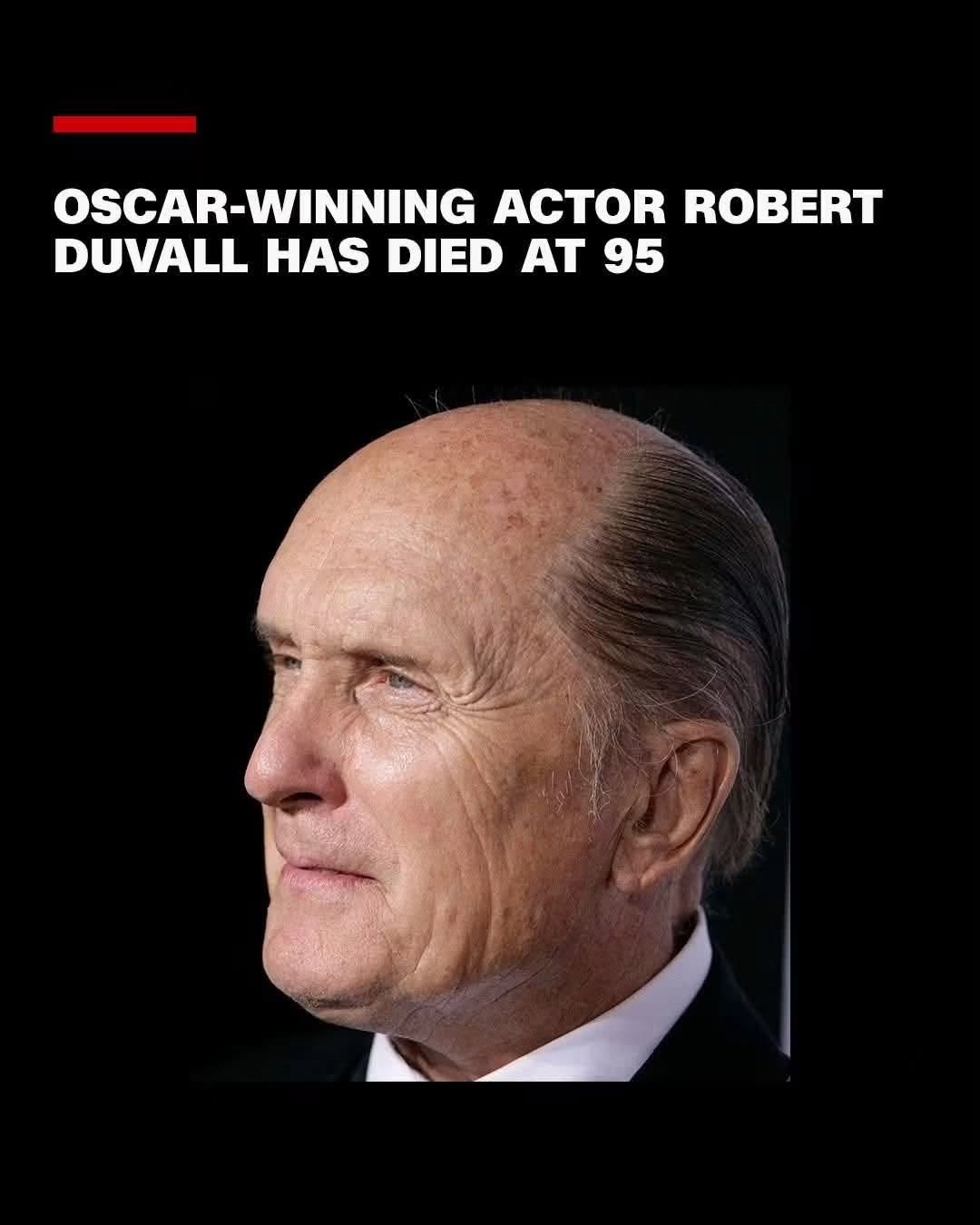
Robert Duvall: Remembering an Oscar-Winning Giant of American Cinema
Robert Duvall, one of the most respected and enduring actors in American cinema, has died at the age of 95. Over a career spanning more than six decades, Duvall built a reputation for extraordinary versatility, understated intensity, and an ability to give even supporting characters remarkable emotional depth. From his unforgettable portrayal of Tom Hagen in The Godfather to his haunting performance as Lieutenant Colonel Bill Kilgore in Apocalypse Now, Duvall became a defining presence in generations of American filmmaking.
His death marks the passing of an actor whose career was far larger than any single role. Duvall worked across crime dramas, westerns, war films, courtroom stories, family dramas, television productions, and independent cinema. He earned an Academy Award for his performance in Tender Mercies and received multiple additional Oscar nominations throughout his career. Yet awards and famous characters tell only part of the story. Duvall’s greatest achievement was perhaps his ability to make audiences believe that the people he portrayed existed before the camera arrived and would continue to exist after the scene ended.
Born in San Diego, California, in 1931, Duvall developed an interest in acting at a time when American cinema was undergoing major changes. He studied at Principia College and later trained at the Neighborhood Playhouse School of the Theatre in New York, where he studied under influential acting teacher Sanford Meisner. That training helped shape an approach centered on natural behavior, emotional truth, and careful observation.
Duvall’s early career was rooted in theater and television. Like many actors of his generation, he gradually built his reputation through smaller roles before becoming a major film star. His screen career began with appearances in the late 1950s, and one of his early breakthrough performances came in the 1962 classic To Kill a Mockingbird. As Arthur “Boo” Radley, Duvall had relatively little dialogue, yet his performance became one of the film’s most memorable elements. The role demonstrated something that would become a defining characteristic of his career: he understood that acting did not always require speaking.
Duvall could communicate enormous amounts through posture, expression, silence, and small gestures. This quality made him particularly effective in roles involving emotionally restrained or complicated men. Rather than announcing what a character was feeling, he often allowed audiences to discover those feelings gradually.
His career changed dramatically when he appeared in Francis Ford Coppola’s The Godfather in 1972. The film, adapted from Mario Puzo’s novel, became one of the most influential works in American cinema. Duvall played Tom Hagen, the adopted son of Don Vito Corleone and the family’s trusted lawyer and consigliere.
Tom Hagen was not a conventional action character. His power came from intelligence, loyalty, diplomacy, and his understanding of the Corleone family’s internal world. Duvall approached the character with restraint. While Marlon Brando’s Don Corleone and Al Pacino’s Michael Corleone commanded enormous attention, Duvall’s Hagen served as a stabilizing presence within the family.
The performance earned Duvall an Academy Award nomination for Best Supporting Actor. More importantly, it established him as one of the leading character actors of his generation. Tom Hagen became inseparable from the mythology of The Godfather, and Duvall returned to the role in The Godfather Part II in 1974.
The success of The Godfather did not lead Duvall to pursue only glamorous leading roles. Instead, he continued to build a career around complex characters. His filmography became notable for its variety. He could play lawyers, soldiers, criminals, fathers, preachers, ranchers, police officers, and deeply troubled men without allowing one performance to simply repeat another.
His collaboration with Francis Ford Coppola continued with Apocalypse Now, released in 1979. The film, inspired partly by Joseph Conrad’s Heart of Darkness, portrayed the Vietnam War through a surreal and psychologically disturbing journey. Duvall played Lieutenant Colonel Bill Kilgore, an eccentric and charismatic military officer.
Kilgore is one of the most memorable characters in American war cinema. He is simultaneously terrifying, absurd, confident, and strangely charismatic. Duvall’s performance captured the contradictions of a military culture in which destruction could coexist with an almost casual appreciation of beauty.
The film’s famous surfing sequence became particularly iconic, and Duvall’s performance helped turn Kilgore into a cultural reference point. His delivery of the character’s memorable observations about combat and surfing demonstrated his ability to combine humor with menace.
The role earned Duvall another Academy Award nomination. It also reinforced his reputation for creating characters who could dominate a scene without behaving like traditional movie heroes.
Perhaps the most important performance of Duvall’s career came a few years later with Tender Mercies. Released in 1983, the film offered a very different kind of role. Duvall played Mac Sledge, an alcoholic former country music singer attempting to rebuild his life.
Unlike the larger-than-life energy of Kilgore, Mac Sledge was quiet, wounded, and introspective. The film depended heavily on Duvall’s ability to communicate regret and vulnerability without excessive melodrama. His performance earned him the Academy Award for Best Actor.
His Oscar-winning portrayal remains one of the strongest examples of his acting philosophy. Mac Sledge does not transform through a series of dramatic speeches. Instead, his redemption emerges through ordinary choices and small moments. Duvall made the character’s struggle feel intimate and believable.
The film also reflected a recurring theme in Duvall’s career: damaged people attempting to find dignity. His characters were frequently flawed, but he rarely treated them as simple villains or heroes. He looked for the human being underneath the role.
Duvall continued to receive major recognition throughout his career. He earned Oscar nominations for The Great Santini, Apocalypse Now, The Apostle, and The Judge, among others. His television work was equally impressive. He received Emmy Awards for his performances and became particularly associated with prestige television projects.
One of his most celebrated television performances came in Lonesome Dove, the acclaimed 1989 Western miniseries. Duvall played Augustus “Gus” McCrae, a charismatic former Texas Ranger. The role allowed him to demonstrate a different side of his abilities, combining humor, warmth, toughness, and melancholy.
For many viewers, Gus McCrae became one of the definitive television Western characters. Duvall’s performance showed why he remained valuable to filmmakers even after decades in the industry. He could make a character feel larger than life while keeping the performance grounded.
Duvall also remained active in later decades, appearing in films such as A Civil Action, The Road, Get Low, and The Judge. His work in The Judge earned him another Academy Award nomination, demonstrating that his abilities remained highly regarded even late in his career.
One reason for Duvall’s longevity was his refusal to rely entirely on celebrity. He did not need to be the central figure in every film. In many productions, his presence strengthened the entire cast. Directors could give him a relatively limited amount of screen time and still expect him to create a character audiences would remember.
This is the hallmark of a great character actor: the ability to make a role feel essential even when the story technically belongs to someone else. Duvall possessed that quality in abundance.
His influence extended beyond individual performances. Younger actors and filmmakers frequently cited him as an example of serious, disciplined screen acting. Duvall represented a generation in which actors were increasingly interested in realism and psychological complexity. He helped demonstrate that an actor did not need to perform loudly to make a powerful impression.
His private approach to fame also contributed to his image. Unlike many Hollywood stars, Duvall generally maintained a relatively low-key public persona. He was respected more for his work than for celebrity spectacle. Interviews often revealed an actor deeply interested in the craft itself.
That dedication was visible in the diversity of his roles. He could move from the criminal world of The Godfather to the battlefield of Apocalypse Now, from the wounded musician of Tender Mercies to the American West of Lonesome Dove. Each role demanded a different emotional vocabulary.
His career also demonstrated the importance of aging in Hollywood. Many actors struggle to find meaningful roles as they grow older, but Duvall continued to work well into his later years. He did not depend on youthful glamour. Instead, filmmakers increasingly valued the authority and life experience he brought to characters.
There is a broader lesson in his career. Cinema is often remembered through its stars, but great films depend on performers capable of making fictional worlds convincing. Duvall belonged to that group of actors whose contributions can be felt even when audiences are not consciously analyzing the performance.
When viewers revisit The Godfather, they see Tom Hagen as an essential part of the Corleone family. When they watch Apocalypse Now, Kilgore remains unforgettable. When they watch Tender Mercies, Mac Sledge’s quiet struggle remains deeply affecting. These characters survive because Duvall gave them something beyond dialogue and appearance: he gave them interior lives.
His death therefore represents more than the loss of an Oscar-winning actor. It marks the end of an era in American acting. Duvall worked alongside some of the most important directors and performers of modern cinema and helped define the style of serious American screen acting.
For audiences who grew up with his films, his death may feel like the closing of another chapter in Hollywood history. For younger viewers discovering his work for the first time, however, his performances will remain available as a lasting education in the possibilities of acting.
Robert Duvall’s legacy is ultimately not defined by the number of awards he received or the length of his filmography. It is defined by the characters he made unforgettable and by the emotional honesty he brought to them.
He understood that a great performance does not always demand attention. Sometimes it is a glance, a pause, a gesture, or a quiet sentence delivered with absolute conviction. That ability allowed him to disappear into characters while leaving an unmistakable mark on the films themselves.
From Tom Hagen’s calculated loyalty to Kilgore’s unsettling confidence, from Mac Sledge’s search for redemption to Gus McCrae’s adventurous spirit, Duvall created a gallery of characters that will continue to speak to audiences long after his passing.
American cinema has lost one of its most distinguished performers. But the films remain, and so does the evidence of a remarkable career. Robert Duvall’s work reminds us why acting remains one of cinema’s most powerful art forms: a talented performer can take words written on a page and turn them into people audiences feel they have truly known.
At 95, Duvall leaves behind a body of work that stretches across generations. His characters will continue to appear on screens, in classrooms, in conversations among film lovers, and in the memories of audiences who encountered his performances at different moments of their lives.
His career was long, varied, and extraordinarily accomplished. Above all, it was authentic. Robert Duvall did not simply play characters. He inhabited them. And that is why, even after his final curtain, so many of those characters will continue to live.