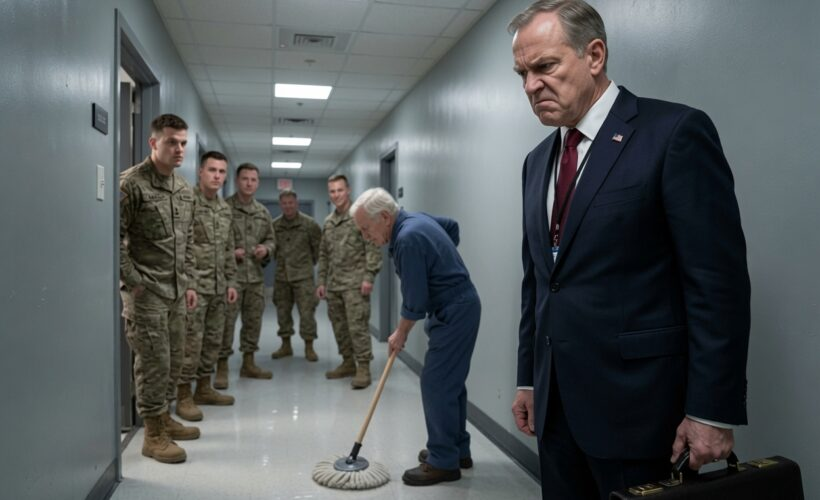
You stand there in the cold hallway. Mop in your hands. Water pooling around your boots.
Four of them. Young. Strong. Camouflage so clean it looks like it never tasted blood.
Sergeant Pearce steps forward first. That smirk cuts deeper than any knife you ever carried.
“You missed a spot, old man.”
You keep your head down. Keep pushing the mop. The wet streaks shine under the fluorescent lights like fresh wounds.
He walks right through it. Deliberate. Boot print dark and ugly on the floor you just cleaned.
“Start over and try not to embarrass yourself this time.”
The others chuckle behind him. You bend lower. Hands shaking just enough for them to see. They think it’s fear.
It isn’t.
“What’s the matter, deaf or just useless?”
You straighten. Slow. Look him dead in the eye. Those blue eyes of his still full of the world he thinks he owns.
“No,” you say. Voice low. Steady. “And you’re making a mistake you’ll regret, Sergeant Pearce.”
The hallway goes quiet for half a second. His smile freezes. Then it comes back wider. Meaner.
He doesn’t know. None of them know.
You’ve scrubbed these floors for years. Watched boys like him come and go. Some never came back. Some came back broken. You remembered every name. Every face. Every secret they thought they left behind.
He steps closer. Breath hot on your face. Still smiling.
You hold the mop handle like it is something else. Something older. Something that has already decided how this ends.
You already know everything about him.
You know the night in Kandahar when the convoy got hit. You know the exact second the RPG punched through the lead Humvee. You know the name of the private who burned alive in the driver’s seat while Pearce radioed for extraction and then went silent. You know because you were the one who pulled what was left of that boy out three hours later. You know because the after-action report never mentioned the two civilians Pearce ordered shot when the smoke cleared. You know because you scrubbed the blood off the floor of the same operations room where the medals were pinned.
You know the girl in Marjah. Seventeen. The one who came to the gate with a basket of bread. You know what Pearce did when the interpreters weren’t looking. You know the way he laughed when she begged. You know because the medic who treated her later sat on these same floors and cried into a bottle until you took the bottle away and listened.
You know the money. The envelopes that never made it to the local contractors. The weapons that somehow appeared on the black market two provinces over. You know the names on the ledgers Pearce thought he burned. You know because the fire never quite reached the bottom drawer of the old filing cabinet in the supply room you mop every Tuesday.
You know the letter. The one from the widow in Ohio. The one that asked why her husband never came home when the official report said he did. You know because you read it. Twice. Then you folded it and put it back exactly where Pearce left it under the mattress of the bunk he no longer uses.
Tonight the hallway smells like bleach and wet concrete and the sharp copper of old memory. The four of them stand in a loose half-circle. Pearce closest. The others still grinning like this is just another game.
You set the mop against the wall. Slow. Careful. The handle clicks once against the tile.
Pearce tilts his head. “You got something to say, old man?”
You do.
You tell him the name of the private who burned. You say it quiet. You watch the color leave his face in strips.
You tell him the name of the girl. You watch his jaw tighten.
You tell him the exact amount that went missing from the contractor fund in the spring of 2012. You watch one of the younger soldiers take a half-step back.
You tell him about the letter. You tell him you still have the copy. You tell him the widow’s phone number is written on the back in the same blue ink he used for his after-action reports.
The hallway is quieter than any battlefield you ever walked.
Pearce’s hand moves toward the sidearm on his hip. Not fast. Not slow. Just the beginning of a decision.
You don’t move.
You have cleaned this floor after worse nights. You have cleaned it after the night the major put a round through his own temple in the latrine. You have cleaned it after the night two specialists beat each other half to death over a poker debt. You have cleaned it after the night the body bags came back from the mountains and no one wanted to look at what was inside.
You have cleaned worse than this.
“You’re finished,” you say.
Your voice doesn’t rise. It doesn’t need to.
Pearce’s smile is gone. The others have stopped chuckling. One of them has already taken another step toward the exit.
You take one step forward. Just one. The water on the floor soaks into the sole of your boot with a soft sound.
“You walked through my clean floor like it was nothing. Like I was nothing. Like the years didn’t matter. Like the names didn’t matter. Like the blood never dried under these lights.”
You look at each of them in turn. You let them see that you remember.
“I remember every one of you. I remember the ones who never came back. I remember the ones who came back wrong. I remember the ones who thought they could bury it under rank and ribbons and clean uniforms.”
Pearce’s hand is still on the pistol. His knuckles are white.
“You can shoot me,” you say. “Right here. Right now. The cameras in this hallway haven’t worked in three years. You know that. I know that. Everyone knows that.”
You take another step.
“But the copy of the letter is already in an envelope. The names are already written down. The ledger pages are already scanned. The medic already talked. The widow already knows the number to call.”
You stop three feet from him. Close enough to smell the coffee on his breath and the starch in his uniform.
“You can kill the janitor. You cannot kill the truth.”
The fluorescent lights buzz overhead like distant insects. Somewhere far down the corridor a door closes. Somewhere outside a truck engine turns over and dies.
Pearce’s eyes are no longer full of the world. They are full of the knowledge that the world has been watching him the entire time.
You lean in just enough that only he can hear the last part.
“I scrubbed your blood off these floors once already. The night you came back from that first deployment with the shakes and the bottle and the knife still in your hand. I cleaned it. I never told a soul. I thought maybe you would grow into the rank. I was wrong.”
You straighten.
“Start over, Sergeant. Try not to embarrass yourself this time.”
You turn your back on him. You pick up the mop. You begin again at the far end of the hallway where the water has already started to dry.
Behind you there is the soft metallic sound of a hand leaving a pistol grip. Behind you there are footsteps moving away. Fast. Not quite running.
You do not look up.
You push the mop in long, even strokes. The wet streaks shine under the lights. The boot print is gone.
You have cleaned worse. You will clean worse again.
But tonight the floor is yours. And the secrets are no longer buried under it.
They are standing in the open. Shaking. And they know your name.
They always did. They just never believed the janitor was listening.