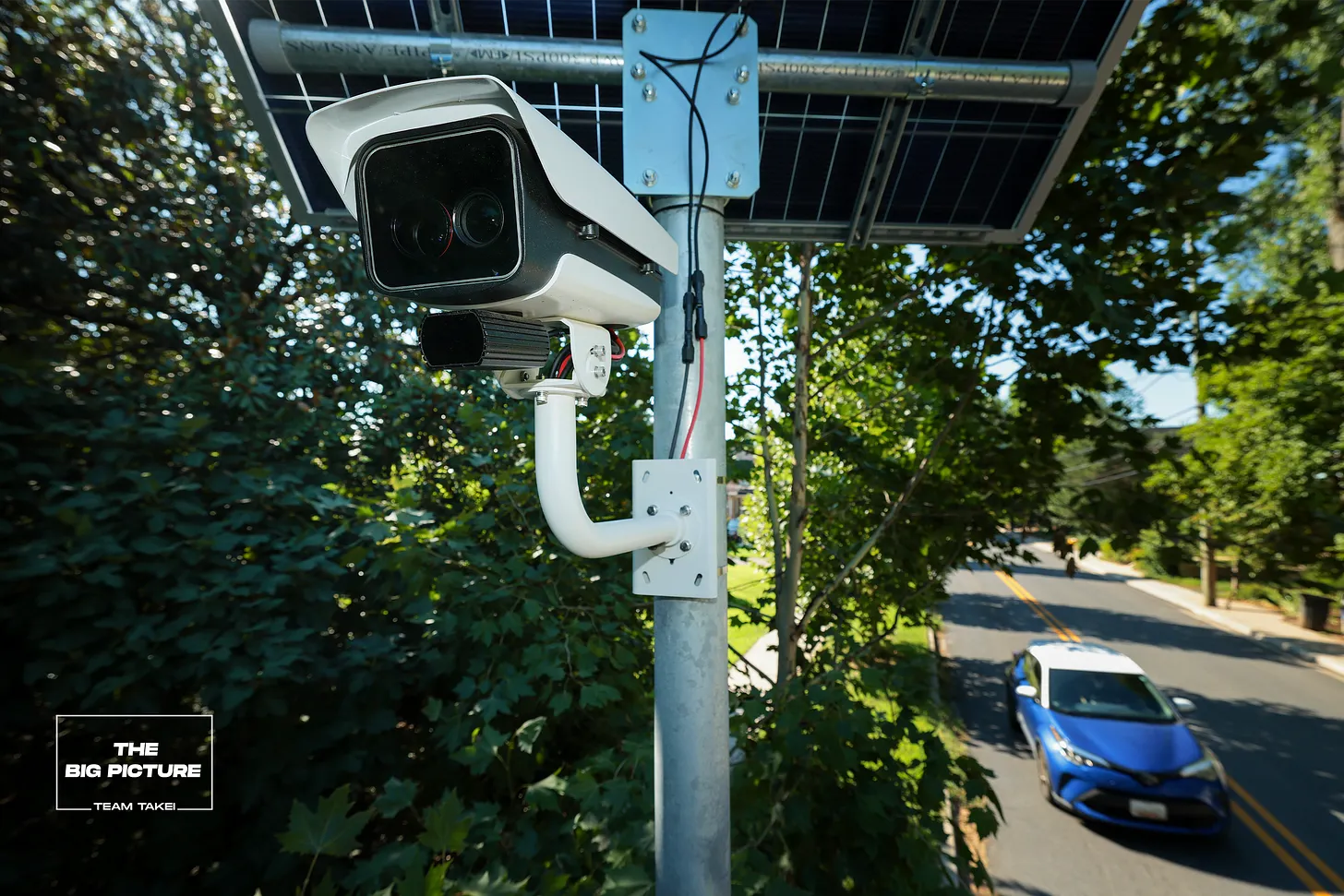
rady O’Rourke steps outside his house in Crystal, Minnesota, a few times a week. His mission? To block a Flock license plate camera with a handwritten sign affixed to a pole. But his stubborn act of defiance isn’t a one-off. It’s part of a pattern NPR identified spanning some 36 states, where irate citizens have stolen, sawed down, crashed into, spray-painted, stickered over or even shot at Flock cameras.
Their reasons boil down to a simple, unifying principle: the U.S. is becoming a Big Brother state, and Flock cameras are helping it get there.
Flock touts more than 5,000 law enforcement agencies that now use its surveillance technology. But high-profile exposés about law enforcement’s egregious misuse of that access have dogged the company. And resistance to the system is organized and growing: DeFlock, an anti-Flock group that maps the company’s footprint nationally, counts more than 130,000 of its plate readers on U.S. streets. It now claims that, in response to public outcry, at least 100 cities have deactivated the AI-powered cameras or canceled contracts with the company.
Flock is keenly aware of the public pushback. It recently announced new privacy measures, including shorter data retention windows, mandatory misuse-detection tools and required case codes for every search. “You’ve asked for stronger privacy, accountability, security and transparency,” Flock said in its announcement, implying it has delivered them. Activists behind the obstruction and vandalism of the cameras call the changes insufficient.
Just as data centers have become physical targets of community pushback against AI’s costs and local impacts, Flock’s cameras have become visible flashpoints of an encroaching surveillance state. The cameras are ubiquitous, but they are also being misused by local authorities and, more recently, bound up in a web of local political dealings as the industry works to influence officials and secure contracts.
Local media and citizen journalists are exposing that machinery, and national political figures are taking note.
Flock markets its cameras as a tool for tracking suspects and solving crimes. In practice, however, law enforcement officers with access to the system have also used it to track their partners, exes, coworkers and relatives.
The creep factor is high. In Milwaukee, a police officer named Josue Ayala used Flock to track a romantic partner 124 times and that partner’s ex 55 times before resigning and pleading guilty. One of the detectives assigned to investigate Ayala, Tehrangi Chapman, was later charged for misusing the same system to track two other people.
Milwaukee’s Common Council responded with a formal letter to the city’s Fire and Police Commission, citing the lack of adequate guardrails, auditing, supervision and transparency in how officers access the system. The department has since cut off officer access pending a review of who actually needs it.
Unfortunately, Milwaukee is not an outlier. A Newsweek investigation found police in at least 12 states — Alabama, California, Florida, Georgia, Illinois, Kansas, Missouri, North Carolina, Pennsylvania, South Carolina, Texas and Wisconsin — faced allegations of using Flock to track romantic partners, relatives or acquaintances. The Institute for Justice’s ongoing count runs to dozens of cases nationally, most surfacing since 2024.
And police departments are not exactly being proactive. The Washington Post found cases of Flock misuse that the officers’ departments had never caught on their own, with agencies learning of the abuse only after reporters brought it to them.
Agency capture
Flock doesn’t always sell its technology at arm’s length to cities and police departments. In at least one striking case, it also hired people with local influence and authority to market its products. The conflicts of interest such an arrangement creates, and its potential for corruption, are highly unsettling.
In Moreno Valley, California, Flock rather brazenly hired the sitting mayor, Ulises Cabrera, to promote its products. Cabrera accepted money from Flock even while his city held an active Flock contract that he had personally voted to fund. In a twist of irony, Cabrera is now suing Flock for wrongful termination, alleging he was fired for refusing to use his office to benefit the company—though one wonders what he thought he was being hired for in the first place. Flock says outside counsel determined that the arrangement complied with California conflict-of-interest law. If true, cities should probably take note: If your mayor is on the Flock payroll, something is amiss.
In Dunwoody, Georgia, some 30 minutes from Flock’s Atlanta headquarters, the city council commissioned an independent security assessment of the company ahead of a vote to expand its contract. But internal emails, obtained under open-records law, show that the official assessment was edited before its release. Specifically, evaluator language recommending “full transparency to potential customers” was stripped out.
And a separate investigation by activist Jason Hunyar of the FOIA Around And Find Out Substack unearthed a calendar invite showing that Flock’s full communications and government-affairs leadership team had met with a Dunwoody police lieutenant ahead of an April 13 vote, where the council unanimously approved roughly $215,000 in new Flock purchases. Hunyar has since filed a formal complaint with the Georgia Government Transparency and Campaign Finance Commission alleging two Flock staffers lobbied city officials without registering as required under state law.
In Denver, Mayor Mike Johnston unilaterally and repeatedly renewed the city’s Flock contract even after the city council unanimously declined to renew an extension last fall. Nine of the city’s 13 council members responded at the time with a formal letter asking the city auditor to block the extension: “We have serious concerns about Flock Group Inc.’s ethics, transparency and credibility… We do not believe the City and County of Denver should continue doing business with a company that has demonstrated such disregard for honesty and accountability,” they wrote.
Flock’s activities also extend to federal influence-buying. The company spent $920,000 on federal lobbying in 2025 and another $430,000 in the first half of 2026 alone, according to OpenSecrets.
The company’s own annual conference has drawn scrutiny over access and secrecy. Activist Benn Jordan, who has spent months documenting security flaws in Flock’s camera network, bought a ticket to the company’s Flock Forward conference in Atlanta this August. Flock emailed him back denying entry, telling him the event was “closed to the Media.” A Flock employee then separately contacted Jordan’s hotel and canceled his personal reservation without his knowledge. In a rather hilarious response, Jordan’s team set up equipment outside the venue anyway, capturing attendee chatter from open microphones inside. It then flew a drone that photographed politicians, police and senators in attendance, a truly fitting bit of karma.
Jordan’s team made a video about the experience and began to name names
The ICE-man watcheth
Flock’s pitch to local communities is clear: Agencies own their data, and only they decide how it’s shared. “Communities deserve tools that protect people and reflect local laws and values, and that means they need to be in control,” the company states on its blog. But the reality is reportedly very different.
The Flock system relies on a centralized database, and critics, including a sitting U.S. senator, have alleged that this architecture allows federal agencies to reach past local control to track people suspected of being in the country without legal status. Sen. Ron Wyden wrote to Flock CEO Garrett Langley last fall alleging the company had misled state and local law enforcement customers about sharing data with federal agencies. His office investigated and found that Homeland Security Investigations, the Secret Service and the Naval Criminal Investigative Service all had access to Flock’s network beyond what the company had disclosed. “I now believe that abuses of your product are not only likely but inevitable, and that Flock is unable and uninterested in preventing them,” Wyden declared.
The gap between the company’s promises and its practices is now the subject of litigation. A California class action,Gibbs Mura v. Flock Safety, alleges that the company’s centralized data system allowed federal agencies to query California license plate data, despite the state’s privacy protections and its immigration sanctuary provisions barring that kind of sharing.The Oxnard Police Department suspended its cameras outright in February after discovering that, despite the department’s access settings being configured to “California only,” a vendor-side issue had enabled nationwide queries anyway. Cities in Santa Clara County have paused their own Flock renewals over similar concerns.
Flock disputes this characterization. The company claims it has no contract with ICE and that federal agencies were removed from national search access in August 2025. It has published a running timeline of the technical safeguards it says it has added since. But so long as the data remains centralized, critics warn there is a risk of federal abuse, particularly by agencies that report to this White House.
A national issue
The backlash against Flock has now reached the 2026 midterms. Axios reports that Flock cameras have become a top “AI boogeyman” in this year’s races, running alongside data centers as flashpoint issues that candidates are campaigning on.
In Michigan, Democratic Senate nominee Dr. Abdul El-Sayed released a video attacking his Republican opponent, Mike Rogers, over Flock, built around a resurfaced 2013 clip of Rogers — then chair of the House Intelligence Committee — telling a congressional hearing, “You can’t have your privacy violated if you don’t know your privacy is violated.” Big Brother would be proud of such logic. El-Sayed’s campaign tied the clip to Rogers’ record supporting the original PATRIOT Act and its 2005 reauthorization. “Mike Rogers out here fighting for the Peeping Tom vote,” El-Sayed wrote in a social media post. “Creepy stuff, Mike.” The Rogers campaign did not respond to a request for comment.
El-Sayed also took aim directly at Flock in a viral video about the surveillance state the company is helping to build.
Flocking together
A YouGov poll published this week found Americans divided on the cameras themselves but more clearly opposed to some uses of the data. Asked whether they support automated license plate readers for law enforcement in their own communities, 38 percent of the 20,563 U.S. adults surveyed said yes and 46 percent said no. Asked specifically about ICE using that same data to track undocumented immigrants, support fell to 36 percent while opposition rose to 50 percent, with strong opposition accounting for 40 percent of respondents.
The public’s attitude toward Flock cameras may sour further the more the technology is misused and the dirtier the politicians touting it are shown to be. Opposition to the surveillance state also crosses partisan lines, with both libertarians and progressives strongly opposed to the technology and its widespread use.
Finally, as with data centers, the more Flock cameras and surveillance are tied to AI, which the system depends on to rapidly match license plates and vehicles, the greater public resistance to their use will be. And because, like data centers, Flock systems are a question of local adoption and use, citizens and activists can and likely will take an increasingly direct role in deciding whether such cameras are permitted in their communities.