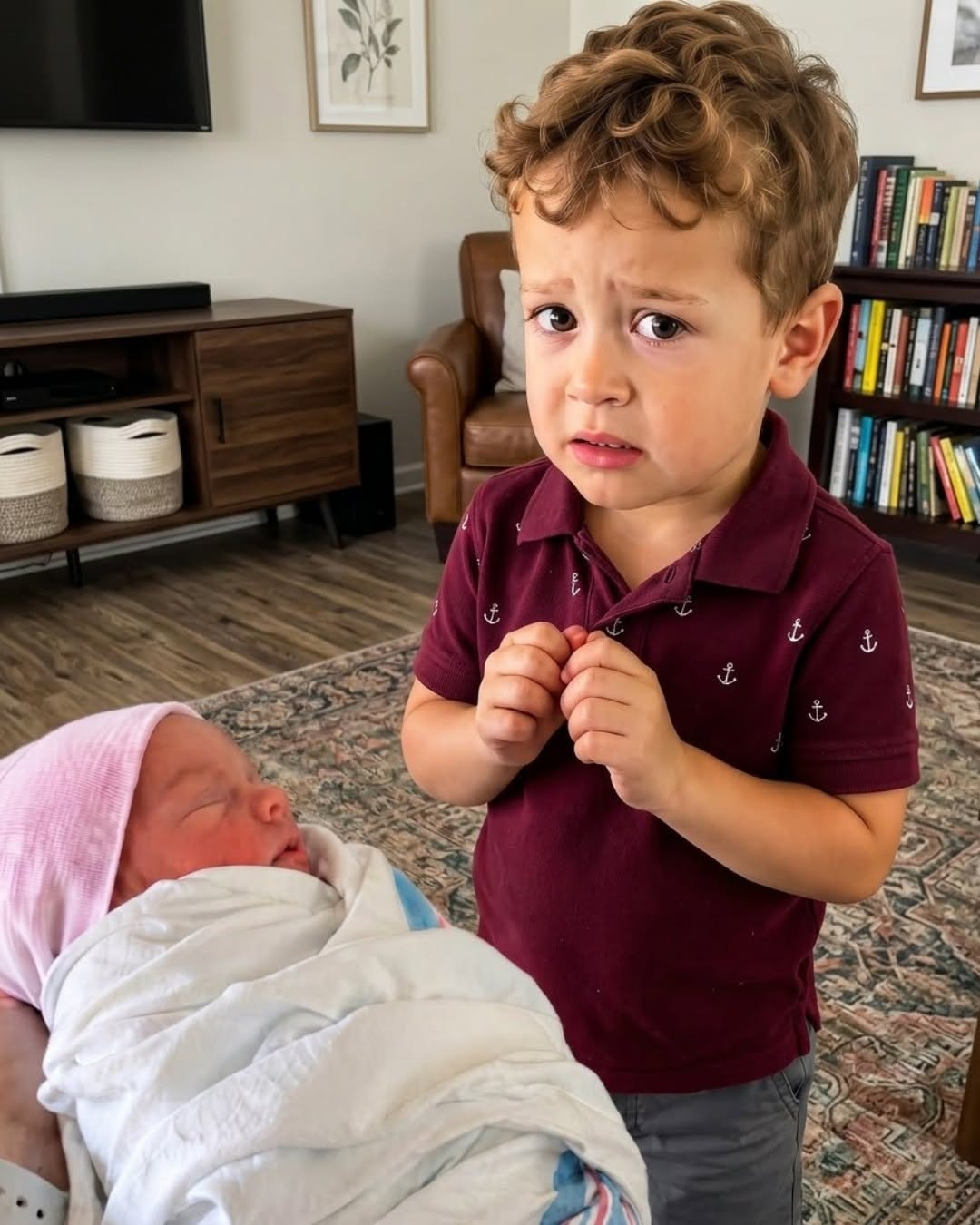
**Part 1 — The Words No Mother Expects to Hear**
The night we finally brought our newborn daughter home, my five-year-old son stopped at the doorway of her nursery and refused to move another step.
I can still remember that moment with painful clarity.
My husband, Daniel, was downstairs struggling with the absurd number of bags we had somehow collected during our three-day hospital stay. I stood beside the crib, exhausted, sore, emotional, and happier than I had felt in months.
Our daughter was finally home.
I had just carefully tucked her beneath the pale pink blanket my mother had knitted when I noticed Max standing in the doorway.
“Come meet your sister in her room,” I whispered.
He remained completely still.
Normally, Max couldn’t stay still for even five seconds. He raced around the house in his socks, constructed elaborate forts from couch cushions, and fired off questions faster than I could answer them.
But that night, he appeared frozen.

His little fingers gripped the doorframe.
His face had turned pale.
And his eyes were fixed on the crib as though something inside it frightened him.
“Max?”
His gaze shifted from the baby to me.
Then he slowly took one step backward.
“Mommy…”
“What is it, sweetheart?”
He swallowed.
“You brought home the wrong baby.”
For a moment, I assumed he was joking.
I even smiled.
“What?”
“That’s not my sister.”
I looked toward the crib.
Our daughter was sleeping peacefully, one tiny fist resting beside her cheek.
“Max, of course she is.”
He shook his head.
“No.”
His voice was barely above a whisper.
“That’s not her.”
Before I could say anything else, he turned around and sprinted down the hallway.
I remained there, watching him disappear, completely confused.
Max had spent my entire pregnancy eagerly waiting for his little sister.
When Daniel and I told him I was pregnant, Max immediately asked if the baby could sleep in his room.
When we explained that babies cried during the night, he reconsidered.
“Okay,” he had said seriously. “She can sleep near Mommy until she learns not to yell.”
He had helped pick the yellow stars painted across the nursery wall.
He chose a stuffed rabbit and named it Mr. Buttons before the baby had even arrived.
Every morning during the final month of my pregnancy, he asked the exact same question.
“Is today baby day?”
And when his sister finally arrived, Max had been overflowing with pride.
Daniel brought him to the hospital the morning after she was born.
I can still see him walking into my room with a bouquet of grocery-store daisies that looked nearly as large as he was.
He carefully climbed onto the bed beside me.
When I placed the baby in his arms, his entire personality changed.
My loud, restless little boy suddenly became perfectly still.
“Her hands are so small,” he whispered.
“She’s small everywhere,” Daniel said.
Max examined every inch of her face.
Then he spotted a faint reddish mark behind her right ear, almost shaped like a tiny crescent.
“What’s that?”
“Probably just a little birthmark,” I said.
Max smiled.
“A moon.”
“A moon?”
“She has a moon kiss.”
From then on, he called it that.
Her moon kiss.
He placed one finger against her tiny hand and made a solemn promise.
“I’m your big brother. I’ll protect you forever.”
Daniel and I nearly cried.
That was the brother I had expected to bring home.
Instead, somewhere between leaving the hospital and reaching our front door, Max had become afraid of the baby.
For the first two days, we assumed jealousy had finally surfaced.
Maybe the reality of having a sister felt different from the idea he had imagined.
Suddenly, Mom was constantly holding the baby.
Dad was changing diapers.
Relatives were calling about the baby.
Flowers were arriving for the baby.
Everything seemed centered around the baby.
So when Max refused to sit beside me while I fed her, I didn’t force him.
When he stopped using her name, I gave him room.
When he walked out of the room whenever she cried, Daniel told me not to worry.
“He’s adjusting.”
That explanation seemed reasonable.
At least, I wanted to believe it was.
But on our third night at home, I woke around 2:00 a.m. to feed the baby.
As I walked back down the hallway afterward, I noticed that Max’s bedroom door was open.
His bed was empty.
My heart jumped.
Then I saw him.
He was sitting on the floor outside the nursery.
His knees were drawn against his chest.
Tears were silently running down his cheeks.
“Max?”
He looked up.
I rushed toward him.
“Sweetheart, what happened?”
He pointed toward the nursery.
“That baby isn’t my sister.”
This time, there was no stubbornness in his voice.
No jealousy.
No anger.
Only fear.
I sat down beside him and took his hands.
“Max, I need you to tell me something.”
He looked toward the nursery once more.
“Why do you keep saying that?”
His fingers tightened around mine.
For several seconds, he remained silent.
Then he leaned close enough for me to feel his breath against my cheek.
“Because I saw what they did at the hospital after Daddy took me to get juice.”
And suddenly, I wasn’t tired anymore.
PART 2 — WHAT MAX SAW
“What did you see?”
Max shook his head right away.
“I don’t want Daddy to be mad.”
“Daddy won’t be mad.”
“He said I was wrong.”
My stomach clenched.
“When did you tell Daddy?”
“At the hospital.”
I stared at him.
Daniel had never said anything about it.
“Tell me everything.”
Max wiped his cheek with the sleeve of his pajamas.
The story emerged slowly.
Not as neat adult sentences.
In fragments.
Images.
Details.
The way children remember frightening moments.
The day before we left the hospital, Daniel had taken Max downstairs to get juice and a snack from the cafeteria.
I remembered that.
I had been exhausted.
Our daughter had just finished feeding, and a nurse had said she would soon be taken for a routine hearing screening.
Daniel offered to take Max downstairs so I could rest.
According to Max, they bought apple juice and crackers.
While Daniel was paying, Max wandered a few yards toward the elevators because he wanted to press the button himself.
Daniel caught up right away.
Nothing unusual there.
But when they reached our floor, Daniel received a work call.
He stood beside the elevator talking while Max walked several steps ahead.
That was when Max noticed two clear hospital bassinets near the nurses’ station.
“And my sister was in one,” he told me.
“How did you know?”
“Her blanket.”
The hospital had wrapped most of the newborns in identical striped blankets.
But my mother had brought us a soft yellow receiving blanket covered with tiny white rabbits.
Max had helped choose it.
“And I saw her moon kiss,” he added.
Something cold moved through my chest.
“What happened next?”
“A lady pushed her away.”
“A nurse?”
He nodded.
“She had blue clothes.”
Scrubs.
“And there was another baby.”
“What other baby?”
“A baby with a pink hat.”
Our daughter’s hospital hat had been white.
Max said the nurse stopped beside another employee.
The women talked for a few moments.
He couldn’t understand everything they said, but one sentence stayed with him because the nurse had sounded frustrated.
“This bassinet is supposed to be in 417.”
Our room had been 412.
Max watched the nurse push the bassinet with the yellow rabbit blanket farther down the hallway.
Then another bassinet was wheeled toward our room.
“I told Daddy that wasn’t her,” Max said.
“What did Daddy say?”
“He said babies were getting checked.”
I closed my eyes.
That sounded exactly like Daniel.
Not because he was careless.
Because there would have been no reason to imagine anything terrible.
Hospitals have procedures.
Babies wear identification bracelets.
Parents wear matching bands.
Nurses scan them.
Everything is checked and double-checked.
At least, that was what we believed.
“Then what happened?” I asked.
“Daddy brought me back to your room.”
“And the baby?”
Max nodded.
“There was a baby beside your bed.”
“The baby we brought home?”
“Yes.”
“How did you know it was different?”
He looked at me as though the answer should have been obvious.
“She didn’t have the moon.”
My breathing stopped for half a second.
I tried to remain calm.
“Max, babies can look different depending on how they’re lying. Maybe you couldn’t see it.”
“I looked.”
“When?”
“When you were sleeping.”
My heart started pounding harder.
“I looked behind her ear.”
He began crying again.
“I told Daddy she wasn’t my sister. He said not to wake you up and that nurses don’t lose babies.”
There was so much pain in his voice that I pulled him against me.
“I’m sorry,” I whispered.
Then another thought struck me.
I gently moved him away.
“Stay here.”
I walked into the nursery.
Our daughter was sleeping.
I turned on the lamp.
My hands were trembling now, even though I kept telling myself how ridiculous this was.
Of course this was our baby.
Of course it was.
I carefully lifted the edge of her cap.
Then I turned her head slightly.
Behind her right ear…
Nothing.
I checked again.
Maybe the mark had faded.
Maybe it was lower.
Maybe it had been caused by pressure during delivery.
I examined the left side.
Nothing there either.
My mouth went dry.
“Daniel!”
He came running from our bedroom.
“What happened?”
I didn’t answer.
I simply pointed toward the baby.
“What?”
“Where’s her birthmark?”
His expression changed.
“What birthmark?”
“The crescent behind her ear. Max called it her moon kiss.”
Daniel looked at Max.
Then at me.
“Sarah, newborns get blotches. It could have disappeared.”
“Get your phone.”
“What?”
“Get your phone, Daniel.”
“Sarah—”
“Please.”
Something in my voice made him stop arguing.
He went into the bedroom and came back with his phone.
“Pull up the pictures from the hospital.”
We sat together on the nursery floor.
Max leaned against my shoulder.
Daniel scrolled backward. There were dozens of pictures.
My mother holding the baby.
Daniel asleep in the chair.
Max holding his sister.
Me kissing her forehead.
Then we came across one taken shortly after Max’s first visit.
I zoomed in.
The image was unmistakable.
Behind our daughter’s right ear was a tiny reddish crescent.
The moon kiss.
Daniel stared at the screen.
Neither of us said a word.
Then I looked at the sleeping baby in the crib.
Her right ear was completely clear.
Daniel whispered my name.
“Sarah…”
I was already grabbing my phone.
PART 3 — “THAT IS NOT POSSIBLE”
I called the hospital’s maternity floor at 2:31 in the morning.
I remember the exact time because I watched the numbers while the phone rang.
A nurse answered.
I explained what Max had told me.
There was a pause.
Then she asked for my full name, date of birth, our baby’s birth date, and the hospital identification information.
I gave her everything.
She placed me on hold.
The waiting music nearly made me lose my mind.
Finally, another woman answered.
She identified herself as the overnight nursing supervisor.
“Mrs. Morgan, I understand why you’re concerned,” she said carefully, “but newborn security procedures make an accidental discharge with the wrong family extraordinarily unlikely.”
“Extraordinarily unlikely isn’t the same as impossible.”
“No, but each infant has identification matching the mother—”
“The baby in my house has a hospital band with my name on it. I know that.”
“Then—”
“My son saw someone wheel my daughter away and another baby into my room.”
Daniel sat beside me, one hand over his mouth.
“And I have photographs,” I continued. “The baby I gave birth to had a mark behind her right ear. The baby in my house does not.”
Silence.
This time, it went on much longer.
When the supervisor finally spoke, her voice had changed.
“Mrs. Morgan, please don’t remove any identification bands. I’m contacting the nursing administrator and our patient safety team.”
“So you think something happened?”
“I’m saying we need to verify everything.”
“Do you have another baby unaccounted for?”
“I can’t discuss another patient.”
“Was another girl born that day?”
Another pause.
“I’m asking you to remain available by phone.”
I stood.
“No. I’m coming to the hospital.”
“Mrs. Morgan—”
“I’m bringing the baby.”
Daniel took the phone from me.
“What exactly do you want us to do?”
The supervisor instructed us to enter through the main emergency entrance, where someone would meet us.
Then she said something that made my knees go weak.
“Please bring any discharge paperwork you were given.”
She was taking this seriously now.
That scared me more than anything else.
Twenty minutes later, we were in the car.
There was no possibility of leaving Max behind.
He refused.
“I know my sister,” he said.
So Daniel drove while I sat in the back between Max and the infant carrier.
I kept staring at the sleeping baby.
And something terrifying happened inside me during that drive.
For three days, I had fed this child.
Held her.
Changed her.
Kissed her forehead.
Rocked her at 3:00 a.m.
I had already begun learning her little sounds.
The soft grunt she made before crying.
The way her fingers curled around mine.
If she wasn’t my daughter, she wasn’t suddenly nothing to me.
She was still an innocent newborn.
Somebody’s newborn.
And if she belonged to somebody else…
Then somebody else might be holding mine.
The thought almost shattered me.

When we arrived, two hospital administrators were waiting for us.
They took us into a private consultation room near maternity.
A nurse checked the baby’s bands.
Then she scanned them.
Everything matched my records.
That should have reassured me.
It didn’t.
“If everything matches,” Daniel asked, “how could she be the wrong baby?”
The administrator, a woman named Patricia Cole, folded her hands.
“We don’t know that she is.”
“But something is wrong,” I said.
“We’re investigating.”
Max tugged on my sleeve.
“Tell them about the yellow blanket.”
I did.
Patricia wrote it down.
Then Max described the two bassinets.
Room 417.
The nurse in blue scrubs.
The pink hat.
The yellow rabbit blanket.
Patricia stopped writing when he mentioned room 417.
I noticed.
“What?”
She exchanged a look with another administrator.
“What is it?”
“We need to review the records.”
“Was there another baby in 417?”
She hesitated.
“Another mother was assigned that room.”
My hands turned cold.
“Did she have a girl?”
Patricia didn’t answer right away.
She didn’t need to.
I knew.
Daniel stood. “Where is that baby?”
“The family was discharged yesterday.”
The room seemed to spin.
I grabbed the table.
Daniel stared at her.
“You let another family leave with a baby who might be ours?”
“We have not established that.”
“Then establish it!”
I had never heard Daniel yell at hospital staff before.
Neither had Max.
He took my hand.
I pulled him close.
Patricia stayed calm.
“We are contacting the other family now.”
“Now?”
“Yes.”
“What if they don’t answer?”
No one responded to that.
For the next forty minutes, we remained in that room.
Forty minutes can feel endless when you have no idea where your child is.
Eventually, Patricia came back.
“They answered.”
I stood so fast that the chair scraped behind me.
“And?”
“They’ve agreed to come in.”
“Do they have my daughter?”
“We still need to confirm—”
“Did their baby have a birthmark behind her ear?”
Patricia’s expression softened.
“The mother says the baby currently in their care has a small reddish mark behind her right ear.”
I stopped breathing.
Beside me, Max whispered:
“I told you.”
Then my five-year-old started sobbing.
PART 4 — TWO MOTHERS, TWO BABIES
The other family arrived shortly before dawn.
I heard them before I saw them.
A woman was crying in the hallway.
Then the door opened.
She looked around my age.
Maybe thirty.
She was dressed in sweatpants, slippers, and an oversized gray sweatshirt.
Her hair was tied into a messy knot.
Her husband carried an infant seat.
The instant I saw the yellow blanket wrapped around the baby, my knees almost gave way.
“My blanket,” Max whispered.
The woman looked at him.
Then she looked at me.
“You’re Sarah?”
I nodded.
“I’m Amanda Bennett.”
She stared at the carrier beside my chair.
Her face crumpled.
“Oh my God.”
For several moments, neither of us moved.
Two mothers stood on opposite sides of a hospital consultation room, each beside a baby the other woman might have given birth to.
There is no single emotion for a moment like that.
Fear isn’t enough.
Grief doesn’t feel right.
Love is there too, somehow.
So is guilt.
Because I desperately wanted the baby Amanda had brought.
But I also felt sick at the thought of handing over the child I had cared for during the last three days.
Amanda started crying harder.
“I kept telling my husband something felt different.”
Her husband rested a hand on her shoulder.
“She thought it was postpartum anxiety,” he explained quietly.
Amanda wiped her face.
“She wouldn’t latch the same way. And I thought her nose looked different. But everyone kept telling me newborns change every day.”
I understood immediately.
Adults had dismissed Amanda for the same reason we had dismissed Max.
Because the truth sounded impossible.
The hospital arranged DNA testing.
Until the results came back, nobody wanted to make assumptions based solely on appearance.
But Max didn’t care about DNA.
He stood beside Amanda’s baby carrier.
“Can I see her ear?”
Amanda looked at me.
I nodded.
She carefully lifted the baby’s hat.
There it was.
A tiny crescent.
Faint red.
Right behind her ear.
Max covered his mouth.
His eyes filled with tears.
“That’s her.”
I started crying before I could stop myself.
I slowly stepped closer.
The baby shifted in her sleep.
One tiny hand slipped free from the blanket.
I knew that hand.
Or maybe I simply wanted to believe I did.
Then she opened her eyes.
And something deep inside me recognized her.
My daughter.
“Hi, Lily,” I whispered.
Amanda made a broken sound behind me.
I turned.
She was staring at the baby beside me.
The baby I had brought into the hospital.
She moved closer.
“Can I?”
“Of course.”
I pulled the blanket away from the infant’s face.
Amanda covered her mouth with both hands.
“Nora.”
Her husband started crying.
That was when I realized something I hadn’t thought about.
Amanda had spent days loving Lily too.
She had fed my daughter.
Rocked her.
Changed her.
Slept beside her.
Whispered promises over her tiny head.
Just as I had done with Nora.
We weren’t enemies battling over babies.
We were two mothers caught inside the same nightmare.
The hospital placed us in separate rooms while the testing was processed.
Thankfully, because both babies had been born there and all four parents had given consent, the process moved quickly.
Those hours were unbearable.
Max curled up beside Daniel on a couch.
At one point, I found him staring down at his shoes.
“What’s wrong?”
He shrugged.
“Are you mad at me?”
My heart cracked.
“Mad at you? Why would I be mad?”
“Because I didn’t tell you sooner.” I sank to my knees.
“Oh, Max.”
“I tried to tell Daddy.”
Daniel immediately knelt beside us.
“You did.”
Max looked at him.
“And I didn’t listen,” Daniel said.
“I thought I knew better because I’m the grown-up.”
Max’s lip trembled.
Daniel held both of his hands.
“I was wrong.”
Children rarely hear adults say those words.
Max stared at him.
Daniel went on.
“You noticed something important. You tried to tell me. I should have listened to you.”
Max leaned against his father.
Daniel hugged him tightly.
“I’m sorry, buddy.”
Around noon, Patricia returned with a physician and another hospital official.
I already knew the answer before they said anything.
The DNA results confirmed it.
The baby Amanda and Eric Bennett had brought to the hospital was biologically ours.
Lily Morgan.
The baby we had taken home was biologically theirs.
Nora Bennett.
For a moment, the room fell completely silent.
Then I closed my eyes and cried.
Relief and grief can exist at the same time.
That was the strangest thing I learned that day.
My daughter was safe.
That was all that mattered.
But I was also about to say goodbye to a tiny girl I had spent three days believing was mine.
Amanda felt the same way.
The hospital offered to have nurses exchange the babies between the rooms.
We refused.
Amanda and I wanted to do it ourselves.
She carried Lily in.
I carried Nora.
For a long moment, we stood facing one another.
I looked down at Nora.
Her eyes were closed.
I touched her cheek.
“You’re going back to your mommy now,” I whispered.
My voice broke.
“You are so loved.”
Amanda was crying too.
She kissed Lily’s forehead.
“Thank you for letting me take care of you for a little while.”
Then we exchanged our daughters.
As soon as Lily settled against my chest, Max hurried forward.
He stopped himself just before touching her.
“Is that really her?”
I smiled through tears.
“That’s really her.”
He looked behind her ear.
The moon kiss.
His whole face changed.
For the first time since we had left the hospital, my little boy smiled.
“Hi, Lily.”
He touched her tiny hand.
“I knew you.”
PART 5 — HOW COULD IT HAPPEN?
The question that followed us for months was the one everyone asked.
How?
How could a modern hospital send two newborn babies home with the wrong families?
The official investigation lasted several weeks.
What we eventually discovered sounded almost impossible because it wasn’t one major mistake.
It was a series of small ones.
That was what made it frightening.
Lily and Nora had been born within hours of one another.
Both were taken for routine screening around the same time.
During part of that period, the hospital’s barcode verification system experienced a temporary network outage.
Staff switched to backup procedures.
According to the investigation, temporary bassinet cards were handwritten while the system was down.
Two babies returning from screening were placed into the wrong bassinets.
Then another mistake followed.
Instead of catching the original error, a staff member relied on the incorrect bassinet information when replacing identification bands that had been removed during testing.
After that, the computer system did exactly what computers do.
It confirmed the information it had been given.
Incorrect information.
By the time the babies returned to our rooms, their bands matched the wrong records.
Every later scan appeared correct.
The hospital repeatedly emphasized that the circumstances were exceptionally rare.
Policies were rewritten.
Staff were retrained.
New verification procedures were introduced so that a temporary system outage could never again allow identification to depend on a single source.
But none of that changed one fact for me.
The system hadn’t found the mistake.
A five-year-old had.
Max noticed because he wasn’t looking at barcodes.
He was looking at his sister.
He knew her blanket.
He remembered her face.
Most importantly, he remembered the tiny moon-shaped mark behind her ear.
And when every adult around him assumed he was confused, jealous, or overwhelmed…
He kept insisting.
“That’s not my sister.”
For a while, Max had nightmares.
He became anxious whenever Lily was out of sight.
If I carried her upstairs, he followed.
If Daniel took her outside, Max wanted to go too.
At her first pediatric appointment, he refused to stay in the waiting room with Daniel.
“I have to see where they take her.”
We realized then that although the nightmare had ended for us, it hadn’t ended for him.
So we got help.
A child therapist explained that Max had experienced something deeply confusing.
He had watched adults make a serious mistake.
He had told people.
Nobody believed him.
Then the thing he feared actually happened. For a five-year-old, that experience shook something deep inside him.
He had always believed grown-ups knew what they were doing.
The therapist helped us restore that trust in an honest way.
Not by teaching him that adults never make mistakes.
But by teaching him something far more important.
Adults can make mistakes.
Children can notice things that matter.
And whenever something feels wrong, he should always tell us.
We promised that we would listen.
Really listen.
Part 6 — THE FAMILY WE NEVER EXPECTED TO MEET
People often ask whether we remained in contact with the Bennetts.
We did.
Not because the hospital requested it.
Not because we were required to.
But because completely separating our lives felt impossible after everything we had experienced together.
Amanda and I started by exchanging occasional texts.
“How is Lily sleeping?”
“Is Nora still making that squeaking noise?”
“Did your pediatrician say the rash was normal?”
Those simple messages eventually turned into longer conversations.
Then coffee.
Then birthday cards.
When Lily and Nora turned one, we met at a park.
Seeing the two girls sitting next to each other on a picnic blanket felt surreal.
Nora had Amanda’s dark eyes.
Lily had Daniel’s smile.
Max sat between them, giving each girl small pieces of soft fruit like an extremely serious waiter.
Amanda laughed.
“He still watches them like security.”
“He takes his job seriously.”
Max heard me.
“I promised.”
I looked over at him.
“Promised what?”
He pointed toward Lily.
“To protect her forever.”
My throat tightened.
He remembered.
Of course he remembered.
By then, Lily’s moon kiss had faded a little, but it was still visible if you knew exactly where to look.
Max checked it from time to time.
Especially after she had just awakened from a nap.
One evening, several months after everything happened, I discovered him sitting beside her crib.
Lily was sleeping.
Max had one hand resting through the bars.
“You okay?” I asked.
He nodded.
Then he whispered, “Mommy?”
“Yeah?”
“What if I didn’t see them?”
I knew exactly what he was asking.
I sat down beside him.
“You did see them.”
“But what if I didn’t?”
I thought about giving him the comforting response.
That someone else would have noticed.
That the hospital would have discovered the mistake.
That everything would have worked out.
But after everything we’d experienced, I didn’t want to reassure him with promises I couldn’t make.
So I gave him the truth.
“I don’t know.”
He looked worried.
Then I placed my hand on his shoulder.
“But you did see.”
He considered that quietly.
“And I told Daddy.”
“You did.”
“And he didn’t believe me.”
Daniel happened to be passing the doorway.
He stopped.
“I learned my lesson,” he said.
Max smiled.
Daniel came inside and sat beside us.
“What’s the rule now?”
Max grinned.
“When Max says something weird, listen first.”
I laughed.
“That isn’t exactly the rule.”
“It should be.”
Daniel nodded seriously.
“I support that rule.”
Part 7 — WHAT THAT NIGHT TAUGHT ME
Lily is older now.
She doesn’t remember any of this, of course.
Someday, we’ll tell her.
We’ll tell her that during her first week of life, she accidentally went home with another loving family for three days.
We’ll tell her about Amanda, who held her and cared for her when I couldn’t.
We’ll tell her about Nora, the tiny girl I loved before discovering she belonged to someone else.
And most of all, we’ll tell her about Max.
The five-year-old boy everyone assumed was jealous.
The little boy who stood outside the nursery and refused to go inside because he knew something the adults didn’t.
I think about that constantly.
How quickly we label children instead of actually listening to them.
He’s jealous.
She’s tired.
He’s looking for attention.
She has an imagination.
Sometimes those explanations are true.
But sometimes behavior is communication.
Max wasn’t staying away from Lily because he resented her.
He was avoiding the nursery because, in his mind, someone else had replaced his sister and nobody seemed to notice.
Imagine how frightening that must have been.
He had promised to protect Lily.
Then he watched her disappear down a hospital hallway.
He told the adult he trusted most.
And that adult told him everything was fine.
So Max did the only thing he knew to do.
He kept telling the truth.
Again.
And again.
And again.
Until someone finally listened.
A few weeks after Lily’s first birthday, I was putting away baby clothes when Max entered her room.
Lily was standing unsteadily beside the crib, holding onto the rails.
Max crouched down in front of her.
“Come on,” he said.
She looked at him.
“Come to Max.”
Lily let go with one hand.
Then the other.
She took one shaky step.
Then another.
And fell directly into her brother’s arms.
Max screamed so loudly that I thought someone had been hurt.
“MOM! MOM! SHE WALKED!”
I rushed into the room.
Lily was laughing.
Max wrapped his arms around her.
“She walked to me!”
Daniel came running upstairs with his phone.
“Do it again!”
Of course Lily refused.
Babies have impeccable timing.
We spent the next ten minutes attempting to persuade her to repeat it.
But all she wanted was Max.
She kept reaching for him.
Eventually, he sat down on the floor and pulled her into his lap.
She grabbed his shirt and rested her head against him.
I watched my children sitting together beneath the yellow stars Max had helped paint before she was born.
Then Lily turned her head.

Behind her right ear was the faintest little crescent.
The moon kiss.
I caught Max looking at it too.
He smiled.
“Still there.”
“Still there,” I said.
Then he looked at his sister and kissed the top of her head.
“I told you I’d protect you.”
I had to turn away for a moment because my eyes filled with tears.
For years, I believed being a parent meant teaching my children how to make sense of the world.
That experience taught me something I will never forget.
Sometimes our children notice things we overlook.
Sometimes they see details adults dismiss.
Sometimes the story that sounds impossible is exactly the one we need to hear most carefully.
And sometimes the smallest person in the room is the only one brave enough to keep telling the truth when nobody believes him.
The night we brought Lily home, I thought my five-year-old son was jealous of his newborn sister.
He wasn’t.
He was terrified because he knew she wasn’t there.
And if Max hadn’t noticed one tiny crescent behind one tiny ear…
Two families might have ended up living completely different lives.
So now, whenever one of my children looks at me and says, “Mom, something’s wrong,” I don’t immediately explain it away.
I listen.
Because once, at five years old, my son looked into a crib filled with blankets, saw a sleeping newborn everyone insisted was his sister, and quietly told us the truth.
“That’s not her.”
And he was right.