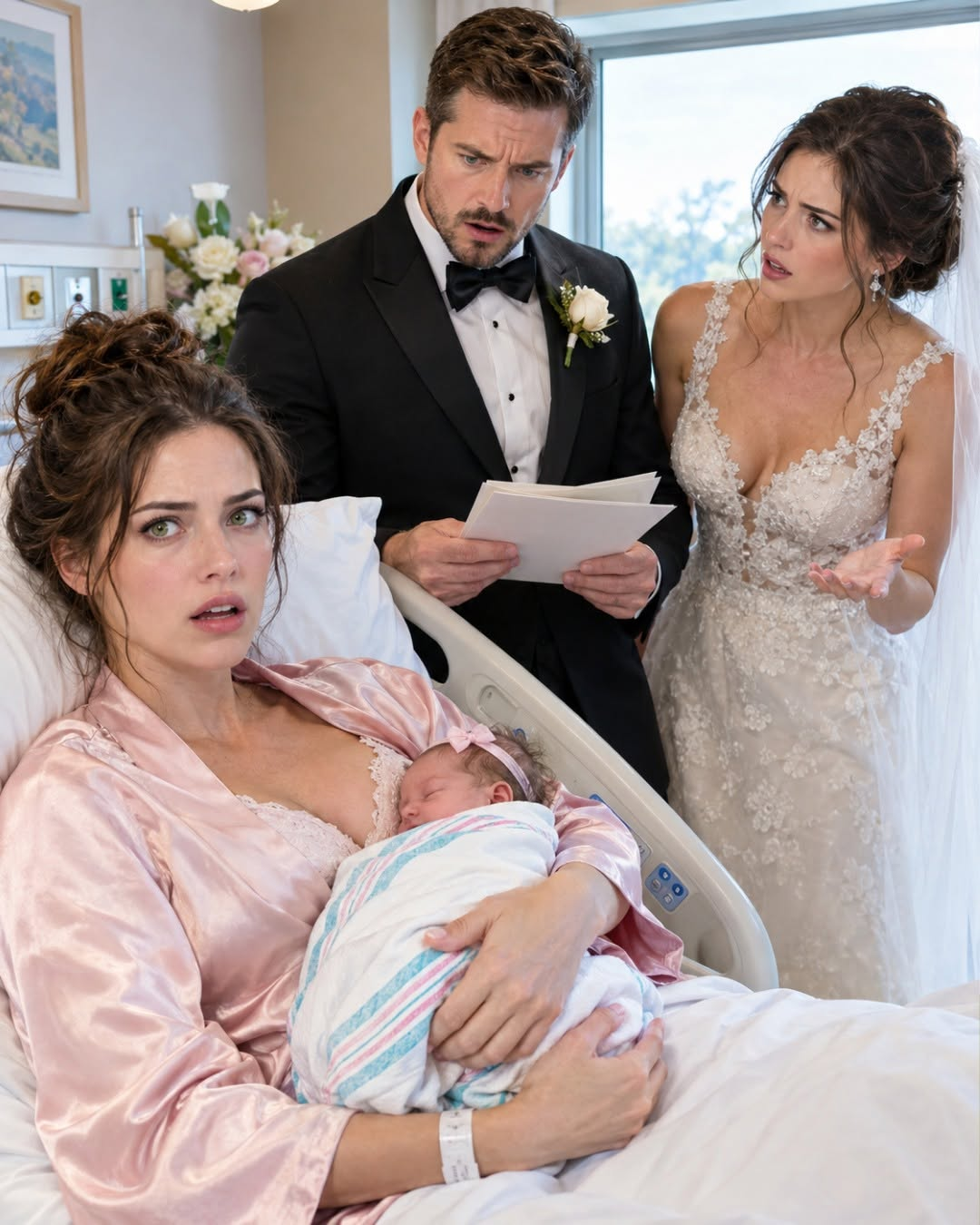
My ex-husband had been married for exactly two hours when he entered my hospital room. His new wife followed him inside. She was still dressed in her wedding gown. I was still in a hospital gown. And between us, asleep against my chest beneath a soft pink blanket, was the daughter he had spent weeks pretending would never complicate his perfect new life.
Adrian Mercer stopped three steps inside the room.
For one brief moment, his eyes landed on the baby.
Then they shifted to me.
Not with wonder.
Not with concern.
Not even with surprise.
With calculation.

I recognized that expression better than I recognized his smile.
Thirteen years beside a man teaches you which face he shows when he is angry, which one he wears when he lies, and which one appears when something has slipped beyond his control.
This was the third.
Behind him stood Celeste Whitmore, his bride.
Her ivory gown glimmered beneath the harsh fluorescent hospital lights, strangely elegant against the beige walls and medical equipment. A loose strand of dark hair rested against her cheek. Her veil had been pushed back, and the smile she had likely worn for photographers all afternoon had disappeared.
Adrian held a black leather folder.
That folder made it obvious why he was there.
He walked toward my bed.
“Claire, we need to settle something immediately.”
I shifted my daughter slightly against my chest.
“No,” I said. “You need my signature.”
His jaw clenched.
Celeste looked at him.
Then at me.
Then at the baby.
“What signature?”
Adrian paid no attention to her.
He set the folder down on the rolling tray beside my bed.
“There are documents here that protect everyone involved.”
I lowered my eyes to my daughter’s tiny face.
Her name was Nora.
She had been alive for fifty-three minutes.
Her father had spent less than thirty seconds in the room, and already he was discussing legal protection.
I looked at him again.
“An NDA?”
He paused.
That was all the confirmation I needed.
I almost smiled.
Adrian had walked in believing he was one step ahead of me.
He had no idea he was already too late.
SEVEN MONTHS EARLIER
The collapse of our marriage started with a cup of coffee.
I remember because I had prepared it exactly how Adrian preferred it—black, with one spoonful of sugar—and placed it beside him before taking my own seat.
I was nine weeks pregnant.
For three days, I had planned exactly how I would tell him.
A tiny pair of white baby socks was tucked inside the upstairs drawer. I had imagined placing them in a gift box after dinner that Saturday.
I never got that opportunity.
That Wednesday morning, Adrian walked into our kitchen carrying a document envelope.
He set it beside my mug.
“I’ve filed.”
I stared at him.
“For what?”
He gave me a look that made it seem as though I was forcing him to say something unnecessarily unpleasant.
“Divorce.”
That was Adrian.
Even ending a marriage was something he treated like an administrative inconvenience.
I opened the envelope.
My hands trembled, although I tried not to let him notice.
“We’ve been together thirteen years.”
“I know.”
“And you filed without even speaking to me?”
“We’ve been having this conversation for years.”
“No, Adrian. You’ve been having it in your head.”
He breathed out and took the chair opposite me.
“Claire, we want different lives.”
I nearly laughed.
For most of our marriage, the life he wanted was the life I had helped him create.
Mercer Coastal Hospitality had begun with one aging hotel outside Savannah and more debt than equity.
By the time Adrian placed divorce papers in my hands, the company operated boutique resorts throughout Georgia and the Carolinas.
Magazine profiles described him as a visionary.
Business publications called him fearless.
Investors called him disciplined.
Hardly anyone knew who had spent years examining the numbers behind his supposedly fearless decisions.
Me.
Before nearly every acquisition, I checked the projections.
Before every refinancing package, I examined the debt structure.
Before Adrian entered investor meetings, I identified the questions they would probably ask.
I wasn’t officially in charge of the company.
I never wanted to be.
I preferred numbers to attention.
Adrian enjoyed attention enough for both of us.
At charity dinners, he would introduce me with one hand resting lightly against my back.
“My wife keeps me grounded.”
People thought it was charming.
What he really meant was:
She fixes things quietly.
But over time, Adrian began interpreting my quietness as proof that I had no ambition of my own.
When I challenged an assumption, he called me cautious.
When I questioned a deal, he said I worried too much.
When I warned him that the debt was rising too quickly, he smiled as if I were a nervous child.
“You handle the details,” he once told me. “I’ll handle the big picture.”
He forgot that sometimes the details are exactly what bring down the big picture.
That morning in our kitchen, he spent fifteen minutes explaining that his company was entering another stage.
Bigger investors were coming in.
More prestigious properties.
National media attention.
I stared across the table at him.
“And I don’t?”
He never answered directly.
He didn’t need to.
Two weeks later, photographs appeared online.
Adrian at a charity gala.
Adrian beside Celeste Whitmore.
Celeste was beautiful, polished, wealthy, and twenty-nine.
More importantly, she was the only daughter of Lawrence Whitmore, founder of Whitmore Capital.
Lawrence controlled the investment Adrian desperately needed for his largest expansion yet.
Suddenly, our divorce became perfectly clear.
It wasn’t about wanting a different life.
Adrian had found a woman who fit more comfortably into the life he was trying to purchase.
THE THING ADRIAN FORGOT
I discovered the pregnancy alone.
I discovered Celeste in public.
I discovered Adrian’s mistake by accident.
Three weeks after he moved out, I started clearing my belongings from our shared office.
Adrian had already removed his personal files.
Or at least, that was what he believed.
At the bottom of a locked desk drawer sat an old portable drive.
I nearly tossed it into a box without checking it.
Then curiosity won.
Most of what was on it was useless—old presentations, archived contracts, tax records.
Then I found several spreadsheets.
I knew Mercer Coastal’s finances well enough to immediately recognize that something was wrong.
Renovation budgets I remembered approving had been altered.
Vendor invoices were higher than the original contracts.
Several consulting companies had received substantial payments despite having names I had never encountered.
One property listed construction costs almost thirty percent above the figure I had reviewed.
I kept opening files.
Then I discovered emails.
Adrian.
Lawrence Whitmore.
Celeste.
Lawyers.
Bankers.
They were discussing a transaction that would essentially combine Whitmore financing with several Mercer properties and restructure ownership of the company.
Most of it was complicated but not surprising.
Until one sentence stopped me.
Claire’s consent could still be necessary under the original capital agreement.
I stopped breathing for a moment.
Then I returned to the sentence and read it again.
Years earlier, Mercer Coastal had nearly collapsed.
Adrian had been thirty-two and believed optimism could serve as a financing strategy.
The banks disagreed.
I had inherited money from my grandmother shortly before the company reached its worst crisis. I invested a significant portion of it to keep the business alive.
Adrian hated that.
He insisted married people shouldn’t need paperwork between them.
My attorney disagreed.
Thank God she did.
That investment gave me a minority ownership stake and approval rights over certain major restructurings, transfers, and mergers.
Adrian apparently believed the divorce would eliminate those rights.
It didn’t.
I opened another email.
This one came from Adrian.
We need Claire resolved before the wedding. She cannot become a disruption afterward.
Resolved.
That was the word he chose.
Not consulted.
Not compensated.
Resolved.
I remained in the office until the afternoon light vanished from the windows.
Then I picked up my phone and called Rachel Bennett, an attorney recommended by an old colleague. I met her the next morning.
She went through everything twice.
Then she looked across her desk at me.
“Has Adrian asked you to sign anything recently?”
“Several things.”
“Have you?”
“No.”
“Good.”
She shut the folder.
“From this point forward, sign nothing without me.”
For the first time since the divorce had started, I felt the ground beneath me finally become steady.
THE SECRET I REFUSED TO TURN INTO A BARGAINING CHIP
Rachel was one of the few people who knew I was pregnant.
My doctor knew.
My sister knew.
A close friend knew.
Adrian did not.
At least, he didn’t then.
I wasn’t intending to keep Nora from him forever.
I wasn’t trying to punish him.
I simply couldn’t stand the idea of turning my pregnancy into yet another negotiation.
Every interaction with Adrian had become a transaction.
Who kept the furniture?
Who was responsible for which account?
When would the house be listed?
Would I give up certain financial claims?
Could I sign one more document?
Could I stop “dragging things out”?
When I asked to communicate through Rachel, he became furious.
His messages came almost every day.
This does not need to be complicated.
Then:
You’re letting lawyers turn this into something ugly.
Then:
I hope you understand that my future cannot remain on hold because you’re emotional about the past.
I saved every message.
One Friday evening, my phone vibrated while I was preparing tea.
The number wasn’t saved.
This is Celeste.
I stared at the screen.
Another message followed.
I know divorce is painful, but sometimes dignity means accepting when someone has chosen a different future. Please stop creating obstacles.
I read it twice.
Then I placed my phone facedown on the counter.
I never responded.
Celeste thought she was protecting her future.
What neither she nor Adrian appeared to understand was that I still legally owned part of it.
THE WEDDING THEY THOUGHT WOULD FIX EVERYTHING
By the end of summer, Adrian and Celeste announced their wedding.
It was going to take place at an oceanfront estate on Hilton Head, with several hundred guests.
Business reporters were invited.
Investors were invited too.
The engagement announcement appeared in regional magazines.
One article described the marriage as “a union of two influential hospitality families.”
I almost admired the wording.
They had turned a wedding into a press release.
Rachel discovered that the Whitmore transaction was scheduled to close within days of the ceremony.
That explained the urgency.
Adrian wanted every potential complication eliminated before he walked down the aisle.
There was just one problem.
I had not approved the restructuring.
And I wasn’t going to.
Not until the unexplained financial discrepancies had been investigated.
Then my doctor gave me another complication Adrian couldn’t control.
“The baby may come early.”
Nora’s due date was still several weeks away.

Apparently, she had no interest in anyone else’s schedule.
The contractions started at six o’clock on the morning of Adrian’s wedding.
At first, I convinced myself they were false labor.
By eight, my sister was driving me to the hospital.
By lunchtime, I was in active labor.
Somewhere sixty miles away, florists were setting up thousands of dollars’ worth of flowers while photographers captured pictures of Adrian adjusting his cuff links.
At 3:18 that afternoon, my daughter entered the world screaming.
She had dark hair.
Long fingers.
And the most serious little expression I had ever seen.
The nurse placed her against my chest.
Every thought of Adrian vanished.
Every email.
Every contract.
Every betrayal.
For several minutes, there was only Nora.
I whispered to her as she slept.
“You don’t have to earn love here.”
I don’t know why those were the first meaningful words I spoke to my daughter.
Maybe because I had spent too many years doing exactly that.
THEN THE DOOR OPENED
Less than an hour later, my sister stepped out to get coffee.
A nurse had just finished examining Nora when someone knocked.
Before I could answer, Adrian entered.
Celeste came in behind him.
I had already seen photographs from the wedding online.
I knew her dress was expensive.
Still, nothing could have prepared me for how surreal it looked in a maternity ward.
She stood there wrapped in silk and lace while I held the child her husband had fathered with me.
I looked at Adrian.
“You left your reception?”
“We have an urgent situation.”
“Clearly.”
His eyes shifted toward Nora again.
“Is that—”
“Yes.”
Celeste turned sharply.
“What?”
Adrian’s mouth tightened.
“Celeste, please.”
She stared at him.
“You said you weren’t sure.”
That caught my attention.
I looked at Adrian.
He already knew.
Maybe he hadn’t known for months.
But he had known long enough.
“How long have you known?” I asked.
“This isn’t the time.”
I actually laughed.
“You came into my hospital room carrying legal papers before asking whether your daughter is healthy, and you’re telling me this isn’t the time?”
Celeste’s face became completely still.
“Your daughter?”
Adrian dragged one hand across his jaw.
“Claire, the transaction has encountered a problem.”
Of course it had.
I looked down at the folder.
“What is it?”
“A confidentiality agreement.”
“Regarding Nora?”
“Regarding everything.”
He opened the folder and removed several pages.
“The timing creates unnecessary exposure for everyone. There will be questions about the divorce, the pregnancy, the wedding, the company. This agreement prevents speculation and protects your privacy too.”
“That’s generous.”
“Don’t turn this into something it isn’t.”
“What is it, then?”
“A practical solution.”
I glanced at Celeste.
Her expression suggested that practical was not the word she would have used.
Adrian slid the papers toward me.
“Sign this tonight. We can negotiate everything else afterward.”
“And then?”
He hesitated.
“The Whitmore closing can proceed.”
There it was.
My daughter wasn’t even an hour old.
Adrian hadn’t asked her name.
He hadn’t asked whether the delivery had gone well.
He hadn’t asked whether I needed anything.
But he had found a way to bring up the closing.
I leaned back against the pillow.
“What happens if I don’t sign?”
His expression hardened.
“Claire, don’t do this.”
“Do what?”
“Create a public disaster because you’re angry.”
Something inside me became completely still.
I had spent thirteen years trying to keep Adrian comfortable.
I corrected his numbers before meetings.
Covered his mistakes before investors noticed them.
Stayed quiet when he took credit.
Smiled through dinners when he interrupted me.
Told myself that peace mattered more than recognition.
Even throughout our divorce, some part of me had still been protecting him.
That part was gone. I reached for the nurse-call button.
Adrian noticed.
“Seriously?”
I pressed it.
A nurse arrived moments later.
“Everything all right?”
“Yes,” I said. “I’d like these visitors to leave unless my attorney is present. My former husband is pressuring me to sign legal documents less than an hour after I gave birth.”
The nurse’s expression immediately shifted.
“Of course.”
Adrian’s face reddened.
“This is ridiculous.”
Then another voice came from the doorway.
“No, Adrian. Showing up here with that agreement was ridiculous.”
Rachel Bennett walked inside.
She carried a gray briefcase and wore the expression of someone who had arrived precisely when she intended to.
I had never been happier to see anyone in a navy suit.
Adrian stared at her.
“What are you doing here?”
Rachel placed her briefcase on the chair.
“My job.”
THE SIGNATURE HE COULDN’T REPLACE
Celeste looked between Rachel and Adrian.
“What exactly is happening?”
Adrian answered first.
“Nothing you need to worry about.”
That proved to be the wrong thing to say.
Celeste narrowed her eyes.
“If my wedding reception is sitting without a bride and groom because we’re standing in your ex-wife’s hospital room, I think I’ve earned the right to worry.”
Rachel looked at me.
I nodded.
She opened her briefcase.
“The restructuring between Mercer Coastal Hospitality and Whitmore Capital cannot proceed in its current form without Claire’s authorization.”
Celeste frowned.
“Why?”
“Because Claire remains a minority owner with contractual approval rights over major structural changes.”
Celeste glanced at Adrian.
He said nothing.
She turned toward Rachel again.
“I was told those rights ended in the divorce.”
“They did not.”
“Adrian?”
His voice turned defensive.
“Our attorneys believed there were options.”
Rachel gave him a steady look.
“Your attorneys understood the agreement perfectly. That’s why you attempted to obtain Claire’s waiver.”
Celeste looked at the NDA.
Then back at Adrian.
“Is that why we’re here?”
“No.”
I finally spoke.
“Yes.”
Adrian turned toward me.
“Stay out of this.”
The sentence was so unbelievable that even Rachel appeared surprised.
I stared at him.
“You’re standing beside my hospital bed asking for my signature on documents involving a company I partly own, and you just told me to stay out of it?”
He seemed to realize how absurd he sounded.
But it was already too late.
Celeste’s expression was shifting.
Rachel still had more to say.
She pulled out a second folder.
“There is another issue.”
Adrian went completely still.
I caught the flash of fear before he managed to hide it.
Rachel continued in an even voice.
“Several financial records have been independently reviewed. There are enough discrepancies in project costs, vendor payments, and consulting contracts that board members were notified this morning.”
Celeste whispered, “What discrepancies?”
“Questions that require answers,” Rachel said. “Until those questions are resolved, the proposed transaction is being suspended.”
Adrian stared at me.
“You sent company documents to the board?”
“I sent documents to my attorney,” I replied. “After discovering figures that didn’t match records I had previously reviewed.”
“You had no right—”
“I own part of the company.”
His mouth shut.
For once, the obvious truth was on my side.
Celeste slowly turned toward him.
“You told my father due diligence was complete.”
“It was nearly complete.”
“You told him there were no material issues.”
“There aren’t.”
“Then why is the deal suspended?”
Adrian looked toward Rachel.
“Because Claire is creating panic.”
I shook my head.
“No. Numbers created the problem. I just stopped hiding them.”
THE QUESTION CELESTE WAS AFRAID TO ASK
For several moments, the only sound in the room was Nora breathing.
Then Celeste looked at her.
Really looked at her.
Something in her expression softened before becoming guarded again.
She quietly asked Adrian, “When did you find out about the baby?”
He didn’t respond.
Her eyes immediately snapped toward him.
“When?”
“A few weeks ago.”
“I was trying to determine whether—”
“Whether what?”
He lowered his voice.
“Whether Claire was actually pregnant with my child.”
I felt anger flare inside me, but Celeste spoke before I could.
“And after you determined that?”
Adrian looked toward the window.
“I intended to explain.”
“When?”
“After the wedding.”
He added, “After the financing was secure.”
Celeste gave one short laugh.
There was no humor in it.
“Of course.”
“Celeste—”
“No. I want to understand this.”
She pointed toward Nora.
“You knew your former wife was pregnant with your child. You knew there was a possibility the baby would arrive around the wedding. You knew Claire still had legal authority over the transaction my father is funding. And you told me none of it.”
“I was managing the situation.”
I will never forget the look on Celeste’s face.
For months, I had imagined her as the woman who stole my husband.
Standing there in that room, I realized something far more complicated.
Adrian had lied to both of us.
In different ways.
But deliberately.
Celeste slowly reached up and removed her veil.
She folded it over one arm.
Then she looked down at her wedding ring.
Adrian noticed.

“Don’t.”
She slipped it from her finger.
“Celeste, don’t make a decision while you’re upset.”
She stared directly at him.
“You married me two hours ago.”
“I know.”
“And your first major decision as my husband was to leave our reception, bring me to your ex-wife’s hospital room, and pressure a woman who just gave birth into protecting your deal.”
“That’s not what happened.”
“It is exactly what happened.”
She glanced down at the NDA.
Then she placed the ring on top of it.
Gently.
No screaming.
No dramatic gesture.
Just gold resting against white paper.
“You seem very interested in agreements today,” she said. “Start with the ones you’ve already broken.”
Then she walked out.
Adrian didn’t follow her.
For several seconds, he simply stared at the ring. What He Finally Saw I don’t know what was happening at the reception.
Perhaps the band was still performing.
Perhaps guests were checking their phones.
Perhaps someone was explaining that the newlyweds had been delayed.
But inside my hospital room, Adrian Mercer silently watched everything he had worked to arrange begin falling apart.
His new wife was gone.
His transaction was frozen.
His board wanted answers.
His ex-wife was no longer afraid of him.
Then Nora made a tiny sound.
Adrian looked toward her.
For the first time since he entered the room, his expression shifted into something I couldn’t easily identify.
“What’s her name?”
“Nora.”
He repeated it softly.
“Nora.”
Then he swallowed.
“She’s mine?”
“Yes.”
He stepped a little closer.
I instinctively pulled her tighter against me.
He noticed.
The realization wounded him.
I could see it.
Good, I thought at first.
Then I surprised myself by feeling nothing.
No satisfaction.
No revenge.
Only exhaustion.
“Why didn’t you tell me?” he asked.
I looked at him.
“There were years when I told you everything.”
His eyes fell.
“I told you when deals were dangerous. I told you when I was worried about us. I told you when I felt invisible. Every time something I said conflicted with what you wanted, you explained why your plans mattered more.”
“Claire—”
“So when I found out I was pregnant, I needed one thing that wouldn’t immediately become part of your strategy.”
His face tightened.
“I had a right to know.”
“You did. And eventually you would have. But you had no right to turn my pregnancy into leverage.”
He glanced at the papers.
Then at Rachel.
“What happens now?”
Those three words almost opened something inside me.
Throughout our marriage, Adrian had always been the one deciding what happened next.
Where we lived.
Which events we attended.
Which deals mattered.
When conversations ended.
When my concerns became inconvenient.
Now he was standing before me asking.
What happens now?
I looked at Nora.
Then back at him.
“Now you leave.”
He blinked.
“I want to see my daughter.”
“Not like this.”
“She’s my child too.”
“And when I’m medically recovered, our attorneys can discuss an appropriate arrangement. You can decide what kind of father you want to become.”
His shoulders lowered.
“But not today,” I continued. “Today I’m recovering from giving birth. Nora needs peace. I need peace. The company can go through Rachel.”
He stared at me.
For once, there was no polished response.
No negotiation.
No clever sentence meant to make me question myself.
He picked up the leather folder.
Celeste’s ring remained on top of the NDA.
He left it there.
At the doorway, he stopped.
I had imagined this moment many times during those lonely months.
In my imagination, I always said something devastating.
Something that would make him understand exactly what he had done to me.
But looking at him then, I realized I didn’t need to hurt him.
Consequences had arrived without my help.
Still, I called his name.
“Adrian.”
He turned.
I held his gaze.
“You spent years believing my silence meant I couldn’t stop you.”
He said nothing.
“It never meant that.”
His eyes shifted toward the baby.
Then the documents.
Then me.
I gave him one final sentence.
“I just didn’t think stopping you was worth losing myself over—until now.”
He walked away.
AFTER THE WEDDING THAT LASTED TWO HOURS
The world didn’t explode the following morning.
That surprised me.
There were no dramatic newspaper headlines.
No reporters waiting outside my house.
No public confrontation.
Instead, consequences came through boring, official paperwork.
Meetings.
Audits.
Emails.
Board resolutions.
Attorney letters.
The Whitmore transaction remained suspended.
Independent accountants examined several years of Mercer Coastal records.
Some discrepancies had reasonable explanations.
Others didn’t.
Several senior employees resigned.
Adrian eventually stepped away from daily management while the board reorganized operations.
I was never interested in taking over the company.
People assumed I would be.
They thought power meant sitting in Adrian’s chair.
They were wrong.
I had spent enough of my life inside his ambitions.
Rachel negotiated the sale of my remaining ownership interest on terms that recognized what I had originally invested and the value those rights carried.
When the final documents arrived, I signed them.
Those were the papers I wanted to sign.
Freedom feels very different when the signature is your choice.
Celeste never returned to Adrian.
At least, not as his wife.
Months later, I received a message from her.
I almost deleted it.
Then I opened it.
I owe you an apology. I spoke to you as though I understood your marriage when I only understood the version Adrian gave me. I wanted to believe him because believing him made my own choices easier. I’m sorry.
I stared at the message for a while.
Then I typed:
I hope you find peace.
That was all.
I didn’t need her guilt.
And I didn’t need her friendship.
Sometimes closure doesn’t require creating a new relationship with the person who hurt you.
Sometimes it simply means no longer carrying the conversation around in your head.
NORA
Adrian eventually became part of Nora’s life.
Carefully.
Slowly.
With boundaries.
There were lawyers at first.
Schedules.
Conditions.
A parenting counselor.
There were missed opportunities and uncomfortable conversations.
There were also moments when he surprised me.
The first time Nora developed a high fever, he stayed awake until morning texting for updates.
On her first birthday, he arrived early instead of sending an assistant with a gift.
For years, Adrian had believed giving something expensive was the same as being present.
Nora was teaching him otherwise.
I never told her what to think about her father.
That relationship belonged to them.
But I also never confused forgiveness with forgetting.
Adrian didn’t regain access to me simply because he was trying to become better.
He had to build his relationship with Nora without using her as a doorway back into my life.
That boundary mattered.
Maybe more than any financial agreement I had ever signed.
THE HOUSE WITH THE YELLOW KITCHEN
Nearly a year after Nora was born, I bought a little house outside Savannah.
It was nothing like the home Adrian and I had shared.
That house had marble countertops nobody cooked on and rooms designed mostly to impress visitors.
My new place had old hardwood floors that creaked.
The upstairs bathroom was too small.
One kitchen cabinet refused to close properly.
There was a huge oak tree in the backyard.
And in the late afternoon, sunlight made the kitchen walls almost golden.
I loved it.
Nora learned to crawl across those floors.
She took her first steps between the couch and the coffee table.
She said “Mama” while holding half a mashed banana.
Some evenings, after putting her to bed, I would sit alone in the kitchen with a cup of tea and think about the woman I had been during my marriage.
I used to believe strength had to be visible.
That it required confrontation.
Raised voices.
Winning arguments.
Proving someone wrong.
Maybe that’s why Adrian underestimated me.
I rarely shouted.
I rarely demanded attention.
I rarely fought simply to be seen.
But quietness was never the same as surrender.
Patience was never permission.
And love was never an agreement to disappear so someone else could shine.
One night, when Nora was almost eighteen months old, I carried her upstairs after she fell asleep against my shoulder.
I laid her in bed and brushed a curl away from her forehead.
Then I stood beside the window.
The backyard was dark except for a small light near the porch.
For years, I had believed the greatest satisfaction would be watching Adrian lose the things he had chosen over me.
His company.
His reputation.
His perfect second marriage.
But standing there, I finally understood something.
His losses were never the victory.
This was.
A sleeping child.
A peaceful home.
A life where nobody required me to become smaller to keep them comfortable.
A life where I no longer woke wondering what Adrian thought of me.
That was the freedom I had been searching for.
The strange thing about being underestimated is that people eventually begin believing their own version of you.
They decide your patience is weakness.
Your kindness is dependence.
Your silence is ignorance.
And sometimes, because you love them, you protect them from discovering how wrong they are.
Until one day, you stop.
Not because you become cruel.
Not because you want revenge.
But because you finally understand that protecting someone from the consequences of their choices is not love.
Sometimes it is simply another way of abandoning yourself.
Adrian walked into my hospital room on his wedding day believing he needed one more signature from the woman he had left behind.
He thought an NDA could preserve the carefully constructed future he had built.

He thought I would cooperate because I always had.
What he didn’t understand was that by the time he reached my bedside, the most important decision had already been made.
Not by the board.
Not by the lawyers.
Not by Celeste.
By me.
I was finished being useful to people who refused to value me.
Finished confusing endurance with loyalty.
Finished protecting a man who had spent years treating my devotion as something he was entitled to.
I never needed to destroy Adrian’s life.
I only needed to stop holding it together for him.
And the moment I did, I discovered something far more satisfying than revenge:
My own life had been waiting for me all along.